
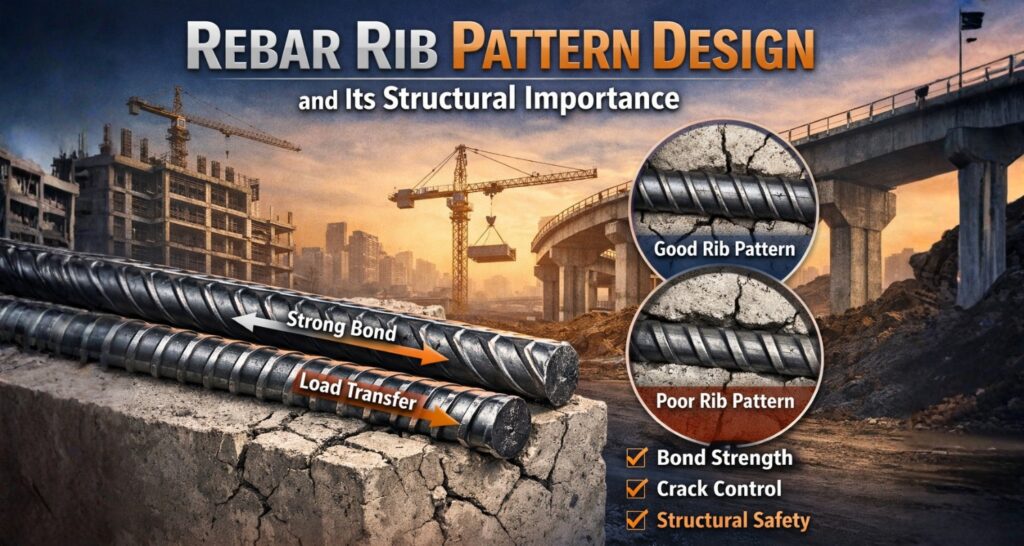
In reinforced concrete construction, rebar is not just about strength, it is about bonding performance. One critical but often overlooked aspect is the rib pattern design on reinforcing bars. These ribs are not decorative. They directly influence how well concrete grips the steel, which ultimately determines the structural integrity of buildings, bridges, and infrastructure.
If your understanding of rebar stops at diameter and grade, that is incomplete. Rib geometry is a core engineering parameter. Ignoring it leads to poor load transfer, slippage, and potential structural failure.
Table of Contents
ToggleWhat Is a Rebar Rib Pattern?
Rebar rib patterns refer to the deformations or raised projections on the surface of steel reinforcement bars. These patterns are engineered to improve mechanical bonding between steel and concrete.
Key components of rib patterns:
- Transverse ribs (main ribs that resist slip)
- Longitudinal ribs (help alignment and stability)
- Rib spacing
- Rib height
- Rib angle
Unlike plain round bars, deformed bars with rib patterns significantly enhance bond strength.
Why Rib Pattern Design Matters in Construction
1. Bond Strength Between Steel and Concrete
Concrete alone is weak in tension. Steel carries tensile forces, but only if it is properly anchored.
Rib patterns create mechanical interlock. This prevents the bar from slipping inside the concrete under load.
2. Load Transfer Efficiency
Rib geometry ensures that forces are transferred from concrete to steel and vice versa.
Poor rib design results in:
- Reduced load transfer efficiency
- Increased crack width
- Structural instability
Optimized rib patterns distribute stress evenly across the reinforcement system.
3. Crack Control and Durability
Ribbed rebar improves crack distribution rather than allowing large cracks to form.
Benefits include:
- Better crack control in concrete
- Increased durability of structures
- Reduced maintenance costs
This is critical in:
- High-rise buildings
- Bridges
- Industrial foundations
Types of Rebar Rib Patterns
1. Standard Rib Pattern
Used in most construction projects. Designed according to international standards such as:
Features:
- Uniform spacing
- Moderate rib height
- Balanced performance
2. High Bond Rib Pattern
Engineered for high-performance structures.
Characteristics:
- Larger rib height
- Optimized rib angle
- Higher bonding capacity
Used in:
- Seismic zones
- Heavy load structures
3. Customized Rib Designs
Some manufacturers develop proprietary rib patterns to improve performance.
These may offer:
- Enhanced anchorage
- Reduced slippage
- Better fatigue resistance
Must Read This: Rebar Spacing Rules in RCC Structures
Key Design Parameters of Rib Patterns
Rib Height
Higher ribs increase mechanical interlock but excessive height can weaken the steel surface.
Rib Spacing
Too close spacing causes stress concentration. Too wide spacing reduces grip.
Rib Angle
The angle affects how forces are transferred. Optimized angles improve anchorage.
Relative Rib Area
This is a critical parameter defined in standards. It determines bonding effectiveness.
International Standards for Rib Design
Rebar rib patterns are not arbitrary. They are governed by strict standards:
- ASTM standards (widely used in the US and globally)
- BS standards (common in the UK and Pakistan)
- ISO specifications
These define:
- Minimum rib height
- Maximum spacing
- Acceptable geometry
Ignoring these standards results in non-compliant and unsafe construction.
Common Problems Due to Poor Rib Design
If rib patterns are not engineered correctly, the consequences are serious:
- Slippage between concrete and steel
- Reduced structural load capacity
- Early cracking and failure
- Increased repair and maintenance costs
This is not theoretical. Many structural failures trace back to poor bonding performance.
Ribbed Rebar vs Plain Rebar
| Feature | Ribbed Rebar | Plain Rebar |
| Surface | Textured with ribs | Smooth |
| Bond Strength | High | Low |
| Slip Resistance | Strong | Weak |
| Usage | Structural projects | Temporary or low load |
Also Read This: Deformed vs Plain Bars – Structural Difference
Applications Where Rib Pattern Is Critical
Rib design becomes even more important in:
- Earthquake-resistant structures
- High-rise buildings
- Bridges and flyovers
- Industrial plants
- Marine structures
In such environments, bond failure is not an option.
Frequently Asked Question
What is the purpose of ribs in rebar?
Ribs improve the bond between steel and concrete, preventing slippage and increasing structural strength.
Why are deformed bars better than plain bars?
Deformed bars have rib patterns that provide better grip and load transfer compared to smooth bars.
How does rib pattern affect bond strength?
The geometry of ribs directly impacts how effectively forces are transferred between concrete and steel.
What is the relative rib area in rebar?
It is a measurement used to evaluate the effectiveness of rib design in providing bonding strength.
Conclusion
Rebar rib pattern design is not a minor detail. It is a structural necessity. The entire concept of reinforced concrete depends on the interaction between steel and concrete, and ribs are the interface that makes this interaction work.
If you are selecting rebar based only on price or diameter, your approach is flawed. Rib geometry, compliance with standards, and bond performance must be part of your evaluation criteria.
In engineering terms, rib patterns are not optional optimization. They are fundamental to structural safety.
