
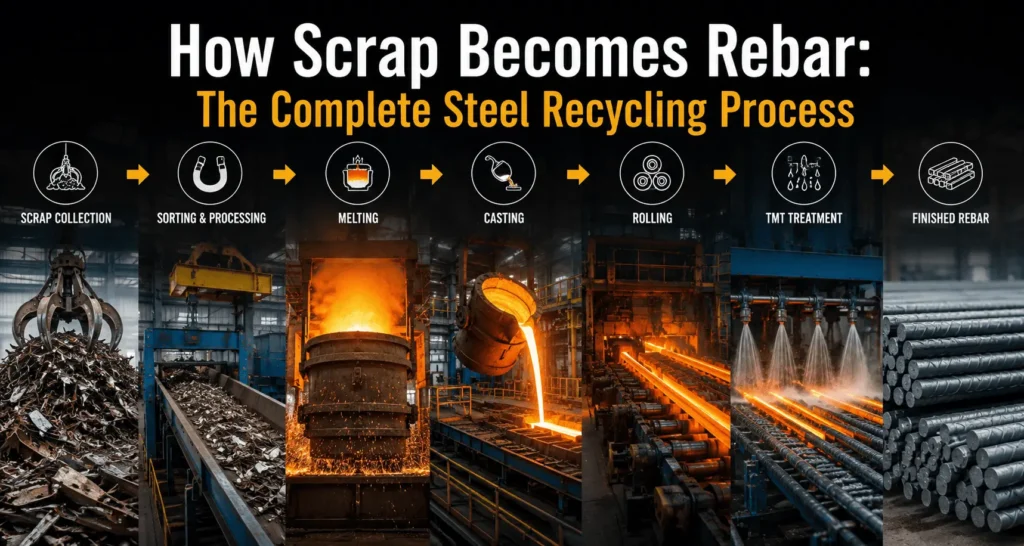
Steel recycling plays a major role in modern construction. Instead of relying only on newly mined raw materials, manufacturers recycle steel scrap to produce durable reinforcement bars (rebar) used in buildings, bridges, roads, and industrial projects.
In this guide, we’ll walk through the complete journey of how scrap steel is transformed into high-quality rebar.
Table of Contents
ToggleWhat Is Steel Scrap?
Steel scrap is recyclable steel collected from demolished buildings, manufacturing facilities, old vehicles, machinery, and construction waste. Since steel can be recycled repeatedly without losing its core properties, it is one of the world’s most sustainable construction materials.
Once collected, the scrap is sent to steel plants for processing.
Step 1: Scrap Collection
The process begins with collecting steel from various sources, including:
- Construction and demolition sites
- Manufacturing industries
- Automotive recycling facilities
- Scrap yards and collection centers
After collection, the scrap is transported to recycling plants where it is prepared for production.
Step 2: Scrap Sorting and Processing
Not all scrap steel is suitable for immediate recycling. It is carefully sorted to remove contaminants such as plastic, rubber, paint, and other non-metal materials.
Common processing methods include:
- Magnetic separation
- Manual sorting
- Shredding
- Shearing
- Baling
Proper sorting improves steel quality and makes the melting process more efficient.
Step 3: Melting the Scrap
The cleaned scrap is loaded into an Electric Arc Furnace (EAF), where extremely high temperatures melt the steel into liquid form.
Compared to traditional steelmaking, electric arc furnaces consume less energy and are well-suited for recycled steel production, making them a preferred choice for sustainable manufacturing.
Step 4: Refining the Molten Steel
Once melted, the steel is refined to achieve the required chemical composition.
During this stage, manufacturers carefully control elements such as carbon, manganese, sulfur, and phosphorus to ensure the steel meets quality standards and delivers the required strength and durability.
Step 5: Continuous Casting
The refined molten steel is poured into continuous casting machines to produce semi-finished products known as Steel Billets.
These billets serve as the raw material for manufacturing reinforcement bars and other long steel products.
Step 6: Reheating the Billets
Before rolling, the billets are reheated in specialized furnaces to reach the proper rolling temperature.
Uniform heating ensures smooth shaping and consistent product quality.
Step 7: Rolling the Rebar
The heated billets pass through a series of rolling mills where they are gradually reduced to the required diameter.
During this process, the characteristic ribs are formed on the surface. These ribs improve the bond between steel and concrete. If you’d like to learn more, read our guide on Rebar Rib Pattern.
Step 8: Thermo-Mechanical Treatment (TMT)
Many modern rebars undergo Thermo-Mechanical Treatment (TMT).
This process combines rapid water cooling with controlled self-tempering to produce bars that offer:
- Higher strength
- Better ductility
- Improved corrosion resistance
- Excellent seismic performance
Step 9: Cutting, Bundling, and Packaging
After cooling, the finished bars are:
- Cut to standard lengths
- Bundled together
- Tagged for identification
- Prepared for storage and shipment
This ensures easy handling and traceability throughout the supply chain.
Step 10: Quality Testing
Before leaving the mill, every batch undergoes strict quality inspections.
Typical tests include:
- Tensile strength
- Yield strength
- Bend tests
- Dimensional accuracy
- Chemical composition
Manufacturers also verify compliance with international standards. For example, if you’re comparing specifications, our article on ASTM A706 vs ASTM A615 explains the differences between two widely used rebar grades.
Where Is Recycled Rebar Used?
Recycled steel rebar is widely used in:
- Residential buildings
- Commercial projects
- Bridges
- Highways
- Dams
- Tunnels
- Industrial facilities
- Marine structures
Its strength and reliability make it suitable for nearly every reinforced concrete application.
Environmental Benefits of Steel Recycling
Recycling steel offers several environmental advantages:
- Reduces the need for iron ore mining
- Conserves natural resources
- Lowers energy consumption
- Decreases greenhouse gas emissions
- Supports a circular economy
These benefits make recycled steel an important part of sustainable construction.
Challenges in Scrap-to-Rebar Manufacturing
Although steel recycling is highly efficient, manufacturers must address challenges such as:
- Scrap contamination
- Fluctuating scrap prices
- Maintaining consistent steel quality
- Rising energy costs
- Environmental compliance
Advanced technology and strict quality control help overcome these challenges.
Future of Steel Recycling
The steel industry continues to evolve with innovations including:
- AI-powered scrap sorting
- Smart manufacturing systems
- Green steel initiatives
- Renewable energy integration
- Hydrogen-based steelmaking
- Digital quality monitoring
These advancements are making steel production cleaner, more efficient, and more sustainable.
Frequently Asked Questions
Can rebar be made entirely from recycled steel?
Yes. Many modern steel mills manufacture rebar primarily from recycled steel scrap while maintaining high quality standards.
Why are steel billets important?
Steel billets are semi-finished steel products that are reheated and rolled into reinforcement bars and other long steel products.
What creates the ribs on rebar?
The ribs are formed during the rolling process and improve the mechanical bond between concrete and steel.
Is recycled rebar as strong as new steel?
Yes. When manufactured under proper quality standards, recycled rebar provides the same structural performance as steel produced from virgin raw materials.
What is the difference between deformed and plain bars?
Deformed bars have surface ribs that improve concrete bonding, while plain bars have a smooth surface. Learn more in our guide on Deformed vs Plain Bars.
How should rebar be placed in concrete?
Correct spacing is essential for structural strength and concrete flow. See our detailed guide on Rebar Spacing Rules.
Conclusion
The journey from scrap to rebar is a remarkable example of how recycling supports both modern infrastructure and environmental sustainability. Through collection, sorting, melting, casting, rolling, and quality testing, discarded steel is transformed into high-strength reinforcement bars used in construction projects worldwide.
Whether you’re selecting materials for your next project or looking for Steel Rebars in Karachi, understanding the manufacturing process helps you make informed decisions. If you’re searching for a trusted supplier, explore our guide to choosing the Best Steel Company in Pakistan to find high-quality steel products backed by reliable service.
