
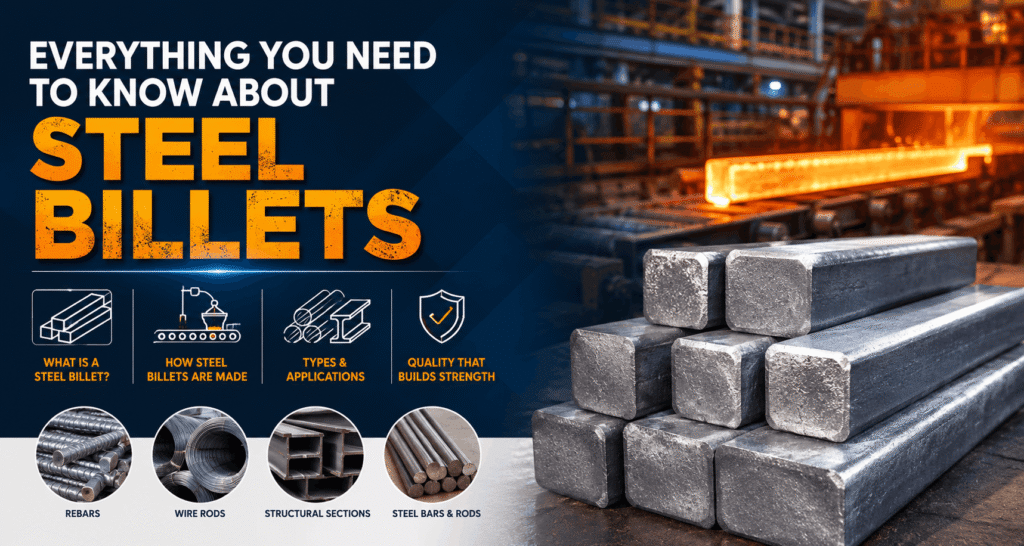
Steel billets are one of the most important raw materials in the steel manufacturing industry. Although they are not used directly in construction, they are processed into products like steel rebars, wire rods, and structural steel sections.
The quality of a steel billet directly affects the strength and durability of the finished steel products. That’s why manufacturers focus on producing High-Quality Billets that meet industry standards. In this guide, we’ll explain what steel billets are, how they are made, their types, and why they are essential for construction and industrial applications.
Table of Contents
ToggleWhat Is a Steel Billet?
A steel billet is a semi-finished steel product produced by casting molten steel into square or rectangular shapes. It serves as the raw material for manufacturing various finished steel products.
Unlike finished products that are ready for use, steel billets require further processing through rolling mills to produce rebars, steel bars, wire rods, and structural sections. Because almost every construction-grade steel product starts as a billet, they are considered the foundation of steel manufacturing.
Why Are Steel Billets Important in Steel Manufacturing?
Steel billets play a vital role in the steel production process. They provide the base material for manufacturing a wide range of steel products used in construction, infrastructure, and industrial projects.
The quality of a billet directly impacts the strength, durability, and performance of the final product. Poor-quality billets can lead to defects, while high-quality billets ensure consistent production and reliable structural performance. Understanding Steel Grades in Construction also helps explain why billet quality is so important.
How Steel Billets Are Made
Collection of Raw Materials
The process begins with selecting quality raw materials such as iron ore, scrap steel, and alloying elements. These materials determine the chemical composition and overall quality of the billet.
Melting Process
The raw materials are melted in high-temperature furnaces to produce molten steel. During this stage, impurities are removed to improve the purity and strength of the steel.
Steel Refining
The molten steel is refined to achieve the required chemical composition. Manufacturers carefully control the alloy content to improve quality, strength, and consistency.
Continuous Casting
The refined molten steel is poured into continuous casting machines, where it solidifies into square or rectangular billets. These billets are then cut into standard lengths for further processing.
Cooling and Inspection
After casting, the billets are cooled under controlled conditions to prevent defects. They are then inspected for surface quality, dimensions, and overall consistency before moving to the rolling process.
Types of Steel Billets
Carbon Steel Billets
Carbon steel billets contain varying amounts of carbon, which affects their strength and hardness. They are widely used for manufacturing construction steel products, machinery components, and engineering materials.
Mild Steel Billets
Mild steel billets have a lower carbon content, making them easy to shape and weld. They are commonly used to produce reinforcement bars, structural sections, and general construction materials.
Alloy Steel Billets
Alloy steel billets contain additional elements such as chromium, nickel, or manganese to improve strength, toughness, and wear resistance. They are widely used in heavy industries, automotive manufacturing, and engineering applications.
Stainless Steel Billets
Stainless steel billets contain chromium, providing excellent corrosion resistance. They are commonly used for food processing equipment, chemical plants, medical equipment, and other environments where rust resistance is essential.
How Steel Billets Are Converted into Finished Products
Steel billets are reheated and passed through rolling mills, where they are shaped into different finished products. Accurate billet dimensions help ensure consistent product quality throughout the rolling process.
Steel Rebars
Steel billets are rolled into reinforcement bars used to strengthen concrete structures.
Wire Rods
Billets are converted into wire rods for manufacturing nails, wires, fasteners, and mesh products.
Structural Steel Sections
Steel billets are processed into beams, channels, angles, and other structural sections used in buildings and infrastructure.
Steel Bars and Rods
Billets are also rolled into round bars, square bars, and rods used in construction, manufacturing, and engineering industries.
Uses of Steel Billets in Construction
Reinforcement Steel Bars (Rebars)
Steel billets are the primary raw material for producing rebars that reinforce concrete structures and improve load-bearing capacity.
Residential Construction
Steel produced from billets is widely used in homes, apartments, and residential buildings for structural support.
Commercial Buildings
Office buildings, shopping malls, and commercial complexes rely on billet-based steel products for strength and stability.
Bridges and Infrastructure Projects
High-quality steel billets contribute to manufacturing durable steel used in bridges, highways, flyovers, and public infrastructure.
Industrial Structures
Factories, warehouses, and industrial facilities require structural steel manufactured from billets to withstand heavy loads and demanding conditions.
Key Quality Factors of Steel Billets
Several factors determine the quality of a steel billet, including:
- Chemical composition
- Surface quality
- Dimensional accuracy
- Strength and consistency
- Compliance with industry standards
Maintaining these quality factors helps manufacturers produce reliable steel products with consistent performance.
How to Identify High-Quality Steel Billets
When purchasing steel billets, look for manufacturers that provide quality certifications, testing reports, and inspection records. Reliable manufacturers follow strict production standards and quality control procedures to ensure consistent billet performance.
If you’re searching for the Best Steel Company in Pakistan, choosing a manufacturer with a strong reputation and certified production processes can help ensure better product quality.
Common Challenges in Billet Manufacturing
Producing high-quality billets requires careful control throughout the manufacturing process. Some common challenges include:
- Impurities in raw materials
- Inconsistent chemical composition
- Surface cracks or defects
- Poor temperature control during casting
Modern steel manufacturers use advanced production techniques and quality inspections to minimize these issues.
Why Billet Quality Matters for Construction Steel
The quality of a steel billet directly affects the performance of construction steel products. High-quality billets produce stronger rebars, more durable structural sections, and reliable steel bars that meet engineering requirements.
Using quality billets also improves structural safety, extends the lifespan of buildings, and reduces the risk of material failure. While selecting construction steel, it’s also useful to understand factors like Steel Rate Fluctuation, but quality should always remain a top priority.
Conclusion
Steel billets are the foundation of modern steel manufacturing. They serve as the starting material for producing rebars, wire rods, structural sections, and many other steel products used in construction and industry.
From raw material selection to continuous casting and quality inspection, every stage of billet production plays a role in ensuring reliable steel performance. Choosing high-quality billets helps manufacturers produce stronger, safer, and longer-lasting steel products, making them an essential part of every successful construction project.
