
When people start planning a construction project, whether it is a house, commercial building, or large infrastructure project, one of the most important materials they need to choose is reinforcing steel (rebar). Steel grades play a big role in determining the strength, durability, and safety of a structure.
Many builders and homeowners often come across grades like Fe-500, Fe-500D, and Fe-600, but they are not always sure what these numbers actually mean or which one is better for their project. Understanding these grades can help you make smarter decisions and avoid costly mistakes during construction.
In this guide, we will explain the differences between Fe-500, Fe-500D, and Fe-600 in simple terms so that you can understand which grade is best for your needs.
Table of Contents
ToggleWhat Do Steel Grades Like Fe-500 Mean?
The term “Fe” comes from the chemical name for iron (Ferrum). The number that follows represents the minimum yield strength of the steel in megapascals (MPa).
For example:
- Fe-500 steel has a minimum yield strength of 500 MPa
- Fe-600 steel has a minimum yield strength of 600 MPa
Yield strength is the amount of stress the steel can handle before it starts to permanently deform. In simple words, it tells you how much load the steel can carry safely.
Higher grade steel usually means higher strength, but strength alone is not always the only factor that matters in construction.
What Is Fe-500 Steel?
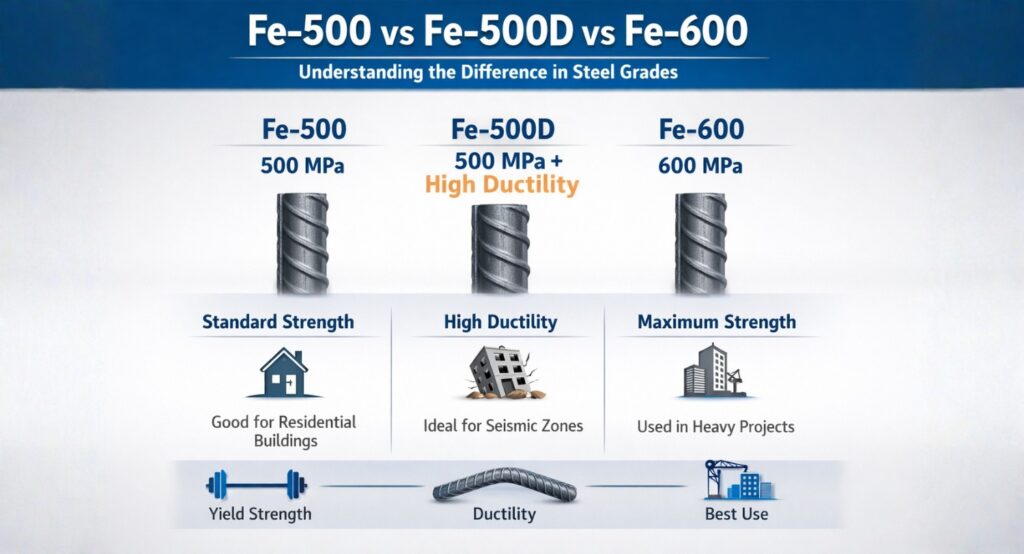
Fe-500 is one of the most commonly used steel grades in construction across many countries. It provides a good balance between strength and flexibility, which makes it suitable for residential and commercial buildings.
This grade is widely used in:
- House construction
- Residential buildings
- Bridges
- Columns and beams
- Reinforced concrete structures
Fe-500 bars are strong enough for most projects while still maintaining enough ductility to handle stress and movement in the structure.
What Is Fe-500D Steel?
Fe-500D is an improved version of Fe-500 steel. The letter “D” stands for ductility, which means the steel has a better ability to bend and absorb energy without breaking.
Compared to standard Fe-500 bars, Fe-500D bars have:
- Higher ductility
- Better elongation
- Improved earthquake resistance
- Better performance under dynamic loads
Because of these properties, Fe-500D is often recommended for earthquake-prone areas and high-stress structures. Engineers prefer this grade because it offers both strength and flexibility, which is very important for structural safety.
What Is Fe-600 Steel?
Fe-600 steel has a higher yield strength compared to Fe-500 and Fe-500D. As the number suggests, it can handle greater stress before deformation.
This grade is typically used in:
- Heavy infrastructure projects
- High-rise buildings
- Industrial structures
- Bridges and large foundations
However, Fe-600 steel usually has lower ductility compared to Fe-500D. This means it may not bend as easily under stress, which can be a disadvantage in certain construction situations.
For this reason, engineers carefully evaluate where high-strength steel like Fe-600 should be used.
Key Differences Between Fe-500, Fe-500D, and Fe-600
| Feature | Fe-500 | Fe-500D | Fe-600 |
| Yield Strength | 500 MPa | 500 MPa | 600 MPa |
| Ductility | Moderate | High | Lower |
| Earthquake Resistance | Good | Excellent | Moderate |
| Flexibility | Good | Very Good | Lower |
| Common Use | Residential buildings | Earthquake-resistant structures | Heavy infrastructure |
Which Steel Grade Is Best for Construction?
The best steel grade depends on the type of project.
For most residential buildings, Fe-500 or Fe-500D works perfectly well. These grades provide strong reinforcement while maintaining flexibility in the structure.
For projects in earthquake-prone areas or structures that require higher ductility, Fe-500D is usually the preferred option because it offers better safety during structural stress.
Fe-600 may be used in specialized projects that require very high strength, but it is usually recommended only after proper structural design and engineering evaluation.
Why Steel Grade Selection Matters
Choosing the right steel grade is important because it directly affects:
- Structural strength
- Safety during earthquakes
- Long-term durability
- Maintenance costs
- Overall construction quality
Using the wrong grade can lead to structural weaknesses or unnecessary material costs. That is why engineers and builders always consider steel grade specifications before starting a project. If you want to know more about steel grade read this: Steel Grades in Construction: A Complete Overview
Final Thoughts
Steel grades like Fe-500, Fe-500D, and Fe-600 may seem like simple numbers, but they represent important differences in strength, flexibility, and performance. Understanding these differences helps builders, contractors, and homeowners choose the right material for their projects.
For most construction projects, Fe-500 and Fe-500D remain the most practical choices because they provide the right balance of strength and ductility. Fe-600 offers higher strength but is generally used in specialized infrastructure where higher load capacity is required.
By selecting the right steel grade, you ensure that your structure remains safe, durable, and reliable for many years.
