
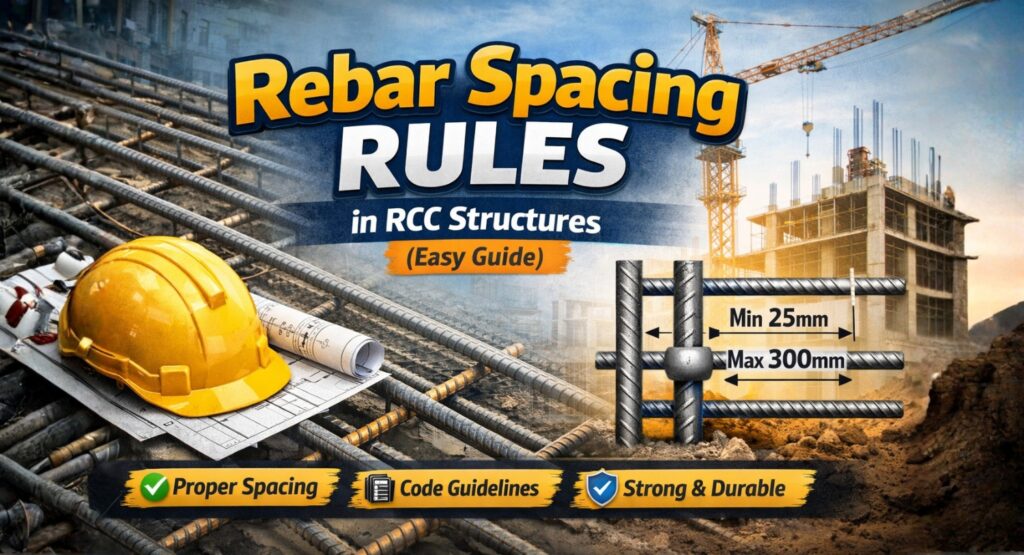
Rebar spacing in RCC (Reinforced Cement Concrete) structures is one of the most critical factors that directly affects strength, durability, and crack control. If spacing is too wide, the structure becomes weak. If it’s too tight, concrete placement becomes difficult.
In this guide, you’ll learn rebar spacing rules in a simple and practical way.
Table of Contents
ToggleWhat is Rebar Spacing?
Rebar spacing refers to the distance between two reinforcing bars in concrete structures such as beams, slabs, columns, and footings.
Proper spacing ensures:
- Load is distributed evenly
- Cracks are minimized
- Concrete flows properly during casting
- Steel and concrete bond effectively
High-quality reinforcement is equally important, which is why choosing a reliable Steel Manufacturing Company plays a key role in overall structural performance.
Why Rebar Spacing is Important
Incorrect spacing leads to serious structural problems:
- Weak concrete zones
- Honeycombing issues
- Reduced durability
- Poor load-bearing capacity
In short, spacing is not just a detail — it controls performance. This is also why engineers prefer sourcing material from the top steel companies in Pakistan to maintain consistent quality.
Standard Rebar Spacing Rules (General Guidelines)
These rules are based on common practices and codes like ACI and IS standards.
1. Minimum Spacing Between Bars
Minimum spacing should be:
- Not less than bar diameter
- Not less than 25 mm
- Not less than 1.33 × maximum aggregate size
👉 This ensures proper concrete compaction and avoids voids.
2. Maximum Spacing in Slabs
For slabs:
- Main reinforcement: ≤ 3 × slab thickness or 300 mm
- Distribution steel: ≤ 5 × slab thickness or 450 mm
👉 Wider spacing increases cracking risk.
3. Spacing in Beams
In beams:
- Bars should be placed to allow proper concrete flow
- Clear spacing ≥ bar diameter or 25 mm
👉 Congested beams = poor compaction = weak structure.
4. Column Reinforcement Spacing
- Minimum clear spacing ≥ 1.5 × bar diameter
- Not less than 40 mm
👉 Columns carry heavy loads, so spacing must ensure full bonding.
5. Footing Reinforcement Spacing
- Typically ranges from 100 mm to 300 mm depending on design
- Must ensure even load transfer to soil
Clear Spacing vs Center-to-Center Spacing
Don’t confuse these:
- Clear spacing = distance between bars (actual gap)
- Center-to-center spacing = distance from center of one bar to another
👉 Engineers mostly specify center-to-center spacing in drawings.
Practical Tips for Proper Rebar Spacing
- Always use spacers and chairs
- Avoid bar congestion at joints
- Follow structural drawings strictly
- Check spacing before concrete pour
Common Mistakes to Avoid
- Placing bars too close → causes honeycombing
- Ignoring aggregate size → blocks concrete flow
- Uneven spacing → leads to stress concentration
- Not following code standards
Conclusion
Rebar spacing in RCC structures is not random — it follows strict engineering rules. Proper spacing ensures strength, durability, and long-term safety of the structure.
If you ignore spacing, you’re not just making a small mistake — you’re compromising the entire structure.
