
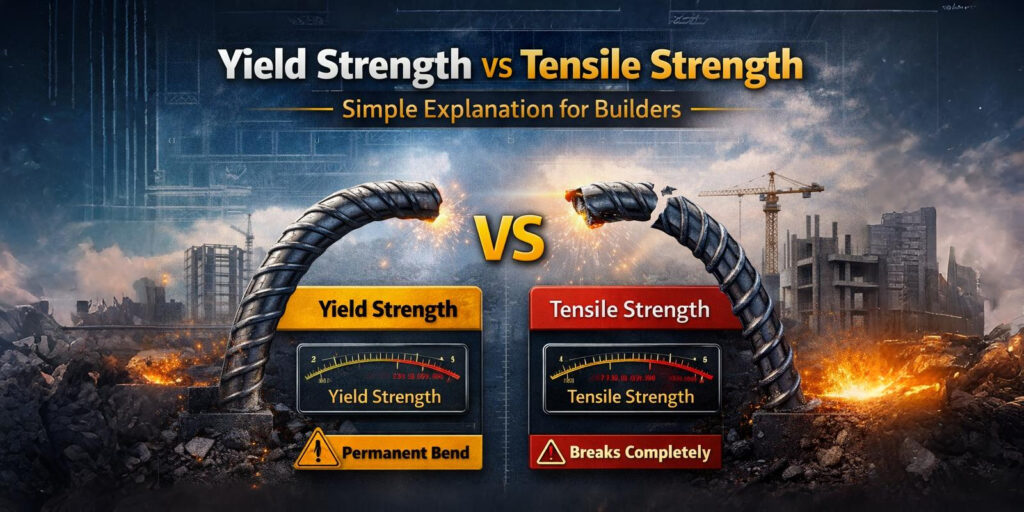
If you are involved in construction, you have probably heard engineers talking about yield strength and tensile strength. These terms may sound technical, but they are actually very simple once you understand the basics.
Table of Contents
ToggleFor builders, contractors, and site supervisors, understanding these two concepts is important because they directly affect safety, durability, and structural performance. Let’s break everything down in a clear and practical way.
What Is Strength in Construction Materials?
When we talk about strength in steel, we are referring to how much force the material can handle before it changes shape or breaks.
In construction, steel bars, beams, and structural sections are constantly under load. That load can come from:
- The weight of the building itself
- Furniture and occupants
- Wind pressure
- Earthquakes
- Vehicles in parking structures
The way steel behaves under this load determines whether a structure remains safe or not.
Two important measures of this behavior are yield strength and tensile strength.
What Is Yield Strength?
Yield strength is the amount of stress a material can handle before it starts to permanently deform.
In simple words, yield strength is the point where steel stops returning to its original shape.
Imagine you bend a steel rod slightly and then release it. If it goes back to its original position, it has not reached its yield point. But if it stays bent, it has crossed the yield strength.
For builders, this is very important because once steel passes its yield point, it cannot fully recover. That means the structure may weaken permanently.
Why Yield Strength Matters in Construction
- It determines how much load a column or beam can safely carry
- It ensures structural stability
- It helps engineers design safe buildings
- It prevents permanent bending in slabs and beams
In reinforced concrete structures, the yield strength of rebars is one of the most critical design factors.
What Is Tensile Strength?
Tensile strength is the maximum amount of stress a material can handle before it completely breaks.
In simple terms, tensile strength tells us how much pulling force steel can tolerate before it snaps.
If you keep stretching a steel bar, it will first bend permanently after the yield point. If you continue applying force, it will eventually break. The stress level at which it breaks is called tensile strength.
Difference Between Yield Strength and Tensile Strength
Let’s simplify the difference:
- Yield strength is when steel starts to permanently bend
- Tensile strength is when steel finally breaks
Think of it like this. Yield strength is the warning stage. Tensile strength is the failure stage.
Both are important, but yield strength is usually more critical in building design because engineers want to prevent permanent deformation.
Which One Is More Important for Builders?
For most construction projects, yield strength is more important.
Why?
Because buildings are designed to avoid permanent damage. Engineers calculate loads in such a way that steel does not reach its yield point under normal conditions.
Tensile strength is still important, especially in extreme situations like earthquakes or structural failure analysis, but day to day structural safety focuses more on yield strength.
Real Example in Construction
Let’s say you are building a house using steel rebars in concrete columns.
If the load on the column exceeds the yield strength of the steel:
- The steel will permanently deform
- Cracks may develop in concrete
- Structural performance will reduce
If the load exceeds tensile strength:
- The steel will break
- Structural failure can occur
This is why engineers carefully select steel grades like Grade 60 or Grade 500 based on their yield and tensile strengths.
Understanding Steel Grades
Steel grades are usually defined by their yield strength.
For example:
- Grade 60 steel typically has a yield strength of 60,000 psi
- Higher grade steel can carry more load before deforming
When you see steel grade numbers, they usually represent yield strength, not tensile strength. This is why yield strength is the main reference point in construction specifications.
If you want a deep understanding about steel grades, we have explained everything in detailed in this blog → Steel Grades in Construction: A Complete Overview
Why Builders Should Care About This
Even if you are not an engineer, understanding these concepts helps you:
- Choose the right steel quality
- Avoid using substandard material
- Understand structural drawings
- Communicate better with engineers
- Ensure project safety
Low quality steel may have lower yield strength than advertised, which can compromise the entire structure.
How Yield and Tensile Strength Affect Cost
Higher strength steel usually costs more.
However, stronger steel can:
- Reduce the amount of material needed
- Improve structural efficiency
- Increase safety margins
Sometimes using better grade steel can reduce long term risk and maintenance costs.
Common Misunderstandings
Many people think tensile strength is the most important factor because it sounds stronger. But in reality, yield strength is usually more critical for structural design.
Another misunderstanding is that higher strength always means better steel. That is not always true. The correct grade depends on the type of structure, load conditions, and engineering design.
Final Thoughts
Yield strength and tensile strength are not complicated once you understand their roles.
Yield strength tells you when steel starts to permanently bend.
Tensile strength tells you when steel completely breaks.
For builders and contractors, knowing this difference helps in selecting the right material, ensuring structural safety, and maintaining construction quality.
Strong structures are not built by chance. They are built by understanding materials and using them correctly.
