
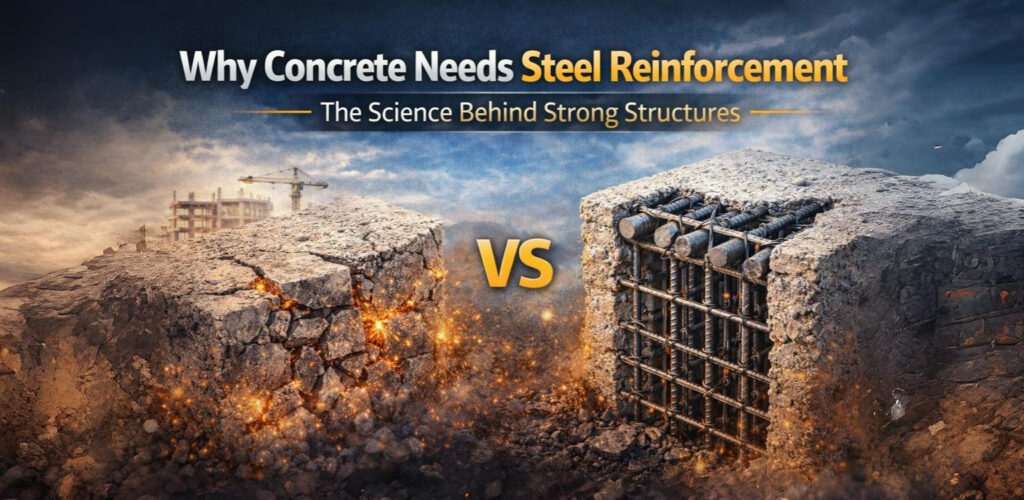
Concrete is the most widely used construction material in the world. From residential homes to bridges, highways, and high-rise buildings, it forms the foundation of modern infrastructure.
Table of Contents
ToggleBut there is an important truth every engineer understands:
Concrete alone is not enough.
To build safe and durable structures, concrete must be reinforced with steel. Let us explore the engineering science behind why steel reinforcement is essential and how this powerful combination creates strong and long-lasting buildings.
The Fundamental Weakness of Concrete
Concrete performs exceptionally well under compression. When heavy loads push downward, concrete can resist significant pressure without crushing. This is why it is ideal for columns and foundations.
However, concrete has a critical weakness.
It is very weak in tension.
Tension occurs when a structural element is pulled, bent, or stretched. In beams, slabs, and bridges, bending forces create tension at certain points. When plain concrete experiences tension, it cracks easily and fails in a brittle manner.
This is where steel reinforcement becomes essential.
Steel: The Solution to Tensile Stress
Steel has properties that perfectly complement concrete:
- High tensile strength
- Excellent ductility
- Ability to absorb and redistribute stress
When steel rebars are embedded inside concrete, they carry the tensile forces that concrete cannot handle. The concrete continues to resist compressive forces, while the steel handles tension.
This combination creates Reinforced Cement Concrete, commonly known as RCC.
If you want to understand more about reinforcement materials and their applications, you can explore our complete guide on steel rebar for a detailed overview.
Steel Rebar: Complete Guide, Uses, Manufacturing, Grades, Pros & Cons, and FAQs
How Reinforcement Works in a Concrete Beam
Consider a simple concrete beam placed across two supports.
When weight is applied:
- The top portion experiences compression
- The bottom portion experiences tension
In a plain concrete beam, cracks form at the bottom where tension is highest. Over time, those cracks expand and the beam fails.
In a reinforced concrete beam, steel bars are placed in the tension zone. The steel absorbs tensile forces and prevents sudden cracking or collapse. This significantly improves structural safety and durability.
Earthquake Resistance and Structural Safety
In regions where seismic activity is possible, reinforcement is even more critical.
Steel reinforcement provides:
- Flexibility during ground movement
- Energy absorption during vibrations
- Controlled cracking instead of sudden failure
Because steel is ductile, it bends before breaking. This warning behavior helps structures survive dynamic forces such as earthquakes, heavy traffic, and wind loads.
High-quality steel rebars play a major role in improving building performance and long-term safety.
Compatibility Between Steel and Concrete
Another important engineering advantage is thermal compatibility.
Steel and concrete expand and contract at nearly the same rate when exposed to temperature changes. This similarity prevents internal stress buildup within the structure.
As a result:
- Bond strength remains intact
- Cracking is minimized
- Structural integrity is maintained over time
This natural compatibility makes reinforced concrete one of the most reliable construction systems in the world.
Crack Control and Load Distribution
Steel reinforcement does more than prevent collapse.
It also:
- Controls micro-cracks
- Distributes loads evenly
- Improves structural stiffness
- Increases overall lifespan
Understanding concepts such as yield strength and tensile strength helps explain why steel is so effective in reinforcement applications. These mechanical properties determine how much stress a material can handle before deforming or failing.
What Happens Without Reinforcement?
Structures made from plain concrete face several risks:
- Early cracking
- Poor resistance to bending forces
- Low durability under dynamic loads
- Increased safety hazards
Modern construction standards require reinforcement because safety cannot be compromised. Choosing a trusted steel manufacturer plays a critical role in structural integrity.
You can learn more about the growing steel industry in Pakistan and its impact on construction here:
The Engineering Formula for Strong Structures
Safe and durable construction depends on combining materials wisely.
Concrete provides compressive strength.
Steel provides tensile strength and flexibility.
Together, they form a structural system capable of supporting heavy loads, resisting environmental stress, and lasting for decades.
This is why reinforced concrete is used in nearly every major infrastructure project across Pakistan and around the world.
Final Thoughts
Concrete alone is strong, but it is incomplete.
Steel reinforcement transforms concrete into a resilient and reliable structural material. It prevents cracking, resists tension, absorbs shock, and enhances safety.
For builders, contractors, and engineers, choosing high-quality reinforcement steel is not just a material decision. It is a structural safety decision.
Strong foundations begin with the right combination of materials.
