
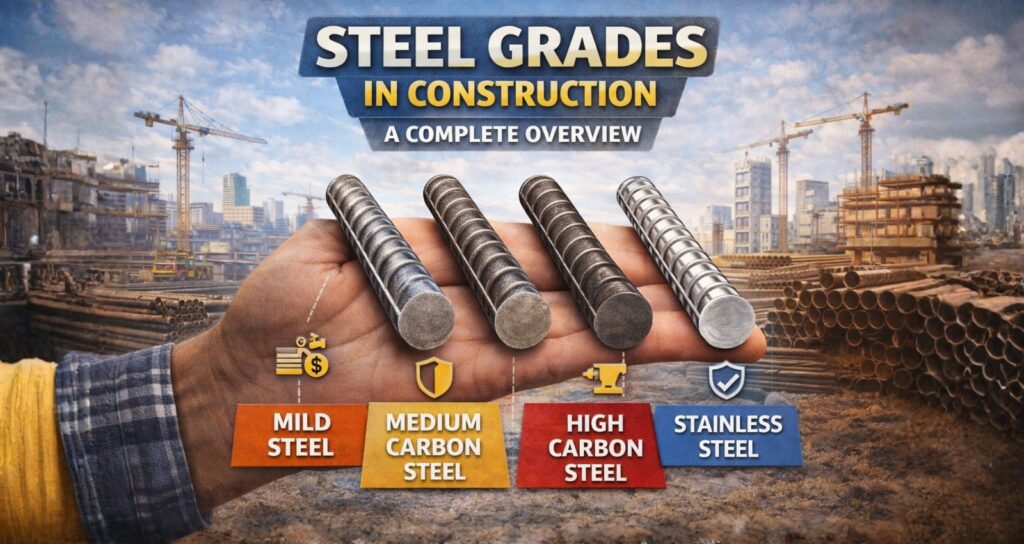
The grade is important in building, and the word “steel” is not enough. Selecting the incorrect grade can result in higher expenses, shorter structural life, and, in the worst situation, failures. Furthermore, the right material selection strikes a balance between cost, performance, and safety since it offers the essential strength without going over budget for pointless specs.
Table of Contents
ToggleThis guide is a practical, no-nonsense walkthrough of common grades used in Pakistan and beyond, how they behave, and simple rules to help engineers, site managers, and buyers pick the right steel for infrastructure.
What “Grade” Means
A target chemical composition and a set of technical requirements that the steel must fulfill are known as a steel grade. Consider grade as three interconnected facts: the metal’s composition, its behavior under load, and the degree to which the mill must regulate production (tolerances and tests).
- Composition: Hardness and strength are controlled by silicon, manganese, carbon, and minor alloying elements. Strength is increased by higher carbon levels, but in this case, welding ability can be reduced.
- Microstructure & processing: Grain structure and toughness can be changed by heat treatment and quenching. For example, controlled cooling gives TMT rebars a hard outer layer and a tough, flexible core.
- Mechanical targets: The behavior of a bar or plate in actual structures is determined by its yield strength, tensile strength (how much load it can withstand before breaking), and elongation (how much it stretches).
Major Grade Systems & Standards You Must Know
Steel grade names differ by system, but the idea is the same, with a standardized promise from mill to buyer. The central systems used in Pakistan and international projects are:
- ASTM (US): ASTM A615 for reinforcement, ASTM A36 for structural steel.
- BS / EN (UK/EU): BS 4449 for rebar, EN 10025 for structural steel (S235, S275, S355 etc.).
- IS (Indian Standards): IS 1786 (rebar), IS 2062 (structural steel). Many Pakistani projects reference these since the specs and suppliers overlap regionally.
- AISI/SAE: It is primarily used for identifying alloy and stainless steels.
If you are wondering, why does this matter? Then keep in mind that defining the norm eliminates uncertainty. For procurement and inspection, always use the standard + grade (e.g., “Fe500, IS 1786” or “ASTM A615 Grade 60”). This makes traceability easier and gives laboratories instructions on what tests to perform. On the other hand, heat/lot number and the same standard should also be included in mill certificates (MTCs).
Reinforcing (Rebar) Grades: Common Types, Properties, and Use-Cases
Rebars today are mostly thermo-mechanically treated (TMT/HYSD), which is a modern approach that provides a flexible core and a strong outer layer. TMT bars outperform old mild steel bars in strength, bendability, and earthquake performance.
Common grade labels in Pakistan and neighboring markets include Fe415, Fe500, and Fe550 (the numbers indicate approximate minimum yield in MPa).
Key mechanical targets:
- Yield strength: The stress at which permanent deformation starts is known as yield strength.
- Ultimate tensile strength: The Maximum load before breaking is known as ultimate tensile strength.
- Elongation (%): Ductility, which is crucial for shaking areas and bending.
- Bend-and-rebend tests: They ensure that the bar won’t crack during site bending.
Where to use which grade (rules-of-thumb):
- Fe415: These are readily accessible as well as reasonably priced. Good for blocks and non-critical components. They are also suitable for bulk concrete and for extra reinforcement.
- Fe500: Ideal for places with greater loads, primary beams, and columns. Using Fe500 can reduce bar sizes or section dimensions, but always check detailing for lap and development lengths.
- Fe550: It is mainly used in high-strength applications, where space is tight or loads are very high. But make sure to use it carefully, as higher strength often means lower elongation.
Effect on detailing: Higher yield shortens development and lap lengths but changes splice design. A higher-grade bar has various lap multipliers per code; that’s why you should always refer to local design standards (ACI, Eurocode, or IS).
Corrosion and coatings: Select zinc-plated steel or stainless steel for severe or coastal settings. Despite being more expensive, coatings increase structural lifespan and reduce long-term maintenance costs.
Structural Steel Grades: Mild, Medium, High-Strength
Different labels are given to structural steel that are used for plates and sections. For routine use, choose low-carbon mild steel; for heavy-duty frames, use stronger plates. ASTM A36 and IS 2062 (mild/structural) are common reference grades; S235, S275, and S355 are the EN versions.
Basic differences and uses:
- Mild steel (A36 / S235): Yield between 235 and 250 MPa. These are perfect for chimneys, simple beams, and ordinary columns since they are simple to construct and weld. For non-critical spans, they are also reasonably priced.
- Medium/high-strength (S275 / S355 / IS2062 E350): Higher yield (275–355 MPa), used where higher load capacity or reduced section sizes are needed.
Fabrication considerations:
- Weldability: Higher-strength steels, particularly those with higher carbon content, may require controlled heating and specific filler metals. To help with welding practice, mill information will display carbon-equivalent values.
- Heat input & thickness: Thick plates and high-strength grades need extra attention with preheat, controlled interpass temperature, and post-weld procedures to avoid cracking.
- Impact toughness: In colder climates or critical bridges, choose grades with guaranteed notch toughness (charpy V-notch) to prevent brittle failure.
When to up-spec: When you need to manage shifting loads (cranes, earthquake), reduce section sizes, minimize dead load, or stick to strict weight budgets. However, keep in mind that costs and fabrication complexity increase, and the best decision needs a compromise between shop/site capabilities and section economy.
Stainless, Alloyed & Special-Purpose Steels
For some tasks, carbon steel is insufficient. Stainless and alloy steels can meet temperature, corrosion, and aesthetic requirements:
- Austenitic stainless (304/316): They have corrosion resistance and formability. For ordinary architectural and sanitary work, use 304; for coastal or chemical-exposed locations, use 316.
- Duplex stainless: Higher strength than 304/316 with good corrosion resistance, and is helpful for pressure vessels and aggressive environments.
- Weathering steels (Corten): They form a protective rust layer that slows further corrosion. Ideally, it is used for architectural finishes and some bridges.
- Low-alloy/heat-resistant steels: They are designed for higher strength or increased temperatures in industrial plants.
Typical uses: Coastal structures, chemical plants, visible architectural facades, marine fittings, and areas with difficult maintenance access.
Mechanical Properties Explained & How They Guide Grade Selection
- Elongation (%): A Higher stretch indicates improved flexibility and energy absorption, which is essential in earthquake-prone zones.
- Toughness/impact energy: Durability against low-temperature structures that are cracking.
- Fatigue limit: Repeated load performance is essential for rotating machinery, cranes, and bridges.
Practical guidance: When you require smaller sections or a greater load capacity, use higher-yield grades. Give greater toughness first priority for structures that are prone to earthquakes. Check the bend-and-rebend test criteria for rebars; even though tensile testing appears to be successful, brittle bars fail these tests.
If thickness or grade requires, check the Charpy V-notch and the suggested preheat/weld techniques for plates. To put it briefly, toughness is equivalent to safety under pressure, and yield is equal to capacity.
How to Choose the Right Grade for Common Applications
- Foundations & footings: If groundwater is aggressive, consider flexible reinforcement (Fe415/Fe500).
- Columns & primary beams: To minimize section sizes and save concrete or steel weight, choose higher yield (Fe500/S355/IS2062 E350).
- Slabs & secondary members: Economical grades (Fe415/A36) are usually sufficient.
- Bridges, cranes, heavy industrial: Use high-strength, fatigue-resistant steels for bridges, cranes, and heavy industry, and take into account low-alloy alternatives. Also, make sure to check the toughness and fatigue data.
- Coastal & corrosive sites: Specify stainless, galvanized, or epoxy-coated rebar and weathering steels for exposed elements.
Match to codes: Always integrate design specifications into the relevant standard (either Eurocode, ACI, IS, or local standards). Weigh cost against longevity because a slightly more expensive grade might need less maintenance and have a longer service life.
Manufacturing, QC, and Verifying the Grade at the Site
Quality starts in the mill. On-site uncertainties are reduced thanks to strict mill control and in-house scraps that offer consistent chemical and mechanical qualities.
Heat/batch number, full chemical analysis, bend test findings, and any impact test data are all included in the Mill Test Certificate (MTC). Additionally, the supplier’s invoice and the drawing specification need to match the MTC.
Site verification:
- Compare heat numbers and bar tags to MTC.
- visual inspections for surface flaws, straightness, and consistent ribs.
- If questions come up, send samples for lab tensile and bend tests.
- If there are portable hardness testers or fast chemical spots, use them.
Conclusion
Cost, safety, and lifetime maintenance are all impacted by grade selection. Always remember that the grade must be specified, MTCs must be required, and problematic batches must be sample tested.
On top of that, consult your structural engineer about the specs before making a purchase, and request lab testing and traceability from vendors.
FAQs
1. What’s the main difference between Fe415 and Fe500?
Fe500, compared to Fe415, has higher yield strength, which makes it different.
2. Can I use mild steel (A36) instead of higher-grade steel for beams?
Yes, you can use mild steel (A36) instead of higher-grade steel for beams.
3. How do I verify a steel supplier’s grade claim?
Ask for Mill Test Reports (MTRs) and other material test certificates
4. Is stainless steel always better for coastal sites?
While stainless steel is better for coastal sites, its effectiveness depends on the grade.
5. How does grade choice affect lap and development lengths?
Higher yield reduces required lengths, but changes splice behavior.
