
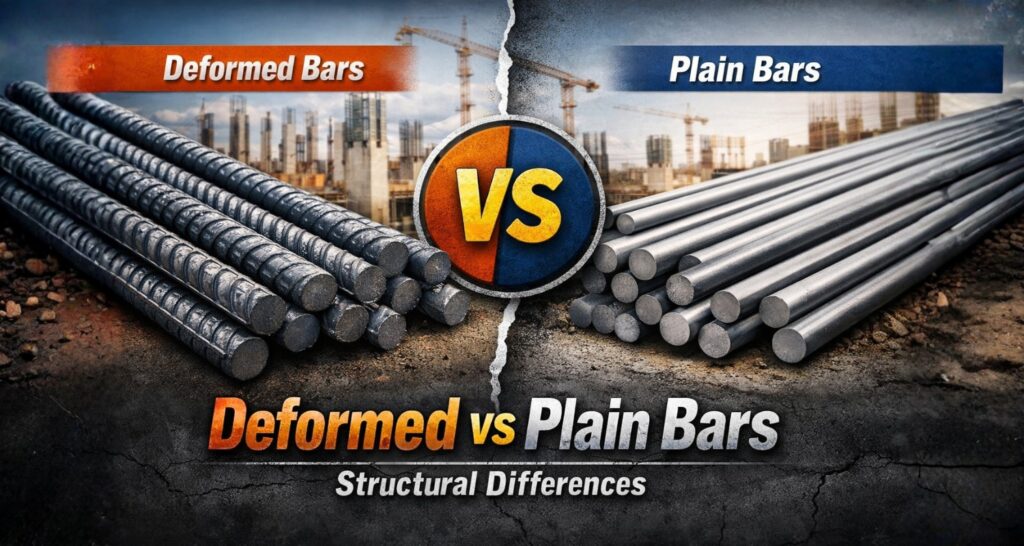
In reinforced concrete structures, steel reinforcement bars (rebars) are essential because concrete alone cannot handle tensile stress effectively. The type of rebar used directly impacts the strength, durability, and safety of a structure. Among the most commonly used options are plain bars and deformed bars. While they may look similar at a glance, their structural behavior is significantly different, and choosing the wrong type can compromise performance.
What Are Plain Bars?
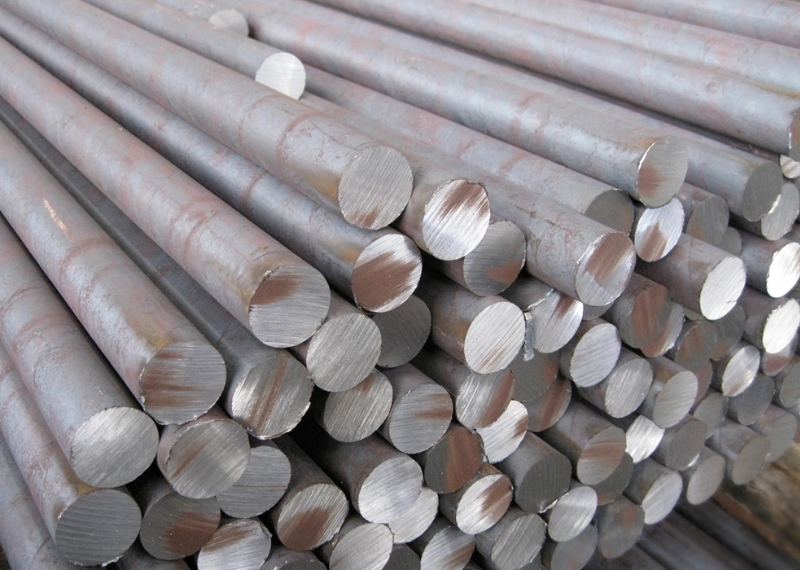
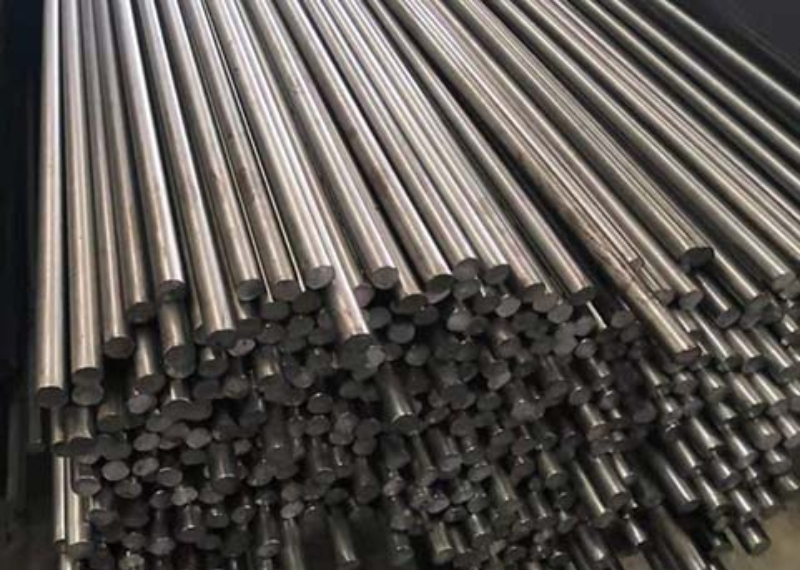
Plain bars are steel reinforcement rods with a smooth and uniform surface. They are typically made from mild steel and have been used in construction for many years.
Key Characteristics
- Smooth surface without ribs
- Lower bond strength with concrete
- Easy to cut, bend, and handle
- More prone to slippage under stress
Applications
Plain bars are mainly used in:
- Small-scale construction projects
- Temporary structures
- Pavements and road works
- Expansion joints (as dowel bars)
Because of their smooth surface, plain bars rely only on adhesion between steel and concrete, which is relatively weak under high stress.
What Are Deformed Bars?
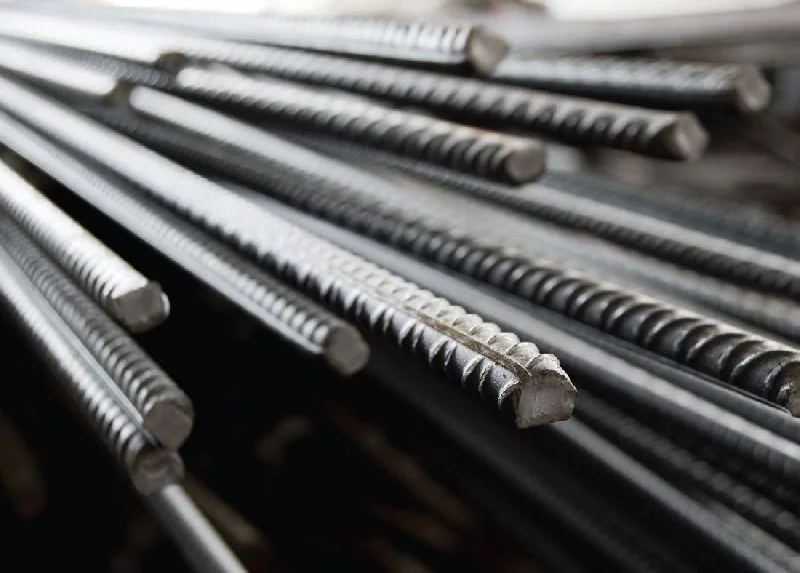
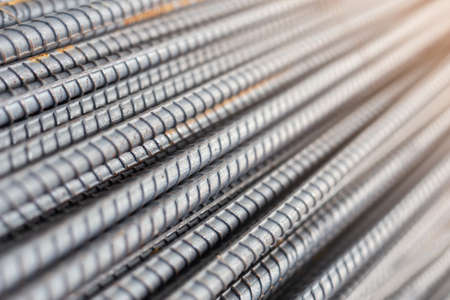
Deformed bars are reinforcement rods with ribs, lugs, or indentations on their surface. These deformations are specifically designed to improve bonding with concrete.
Key Characteristics
- Ribbed or textured surface
- High bond strength with concrete
- Excellent resistance to slipping
- Better load distribution
- Higher tensile strength
Applications
Deformed bars are widely used in:
- Residential and commercial buildings
- Bridges and highways
- Foundations and columns
- Heavy-load structural components
Their design ensures a mechanical interlock with concrete, making them the preferred choice in modern construction.
Structural Difference (Core Comparison)
| Factor | Plain Bars | Deformed Bars |
| Surface Texture | Smooth | Ribbed / Textured |
| Bonding Mechanism | Adhesion only | Mechanical interlock + adhesion |
| Slip Resistance | High slipping risk | Minimal slipping |
| Load Transfer Efficiency | Lower | Higher |
| Tensile Performance | Moderate | High |
| Durability | Lower in heavy stress | High durability |
| Usage | Light-duty | Heavy-duty |
Why Bond Strength Matters
The main structural difference lies in how each bar interacts with concrete.
Concrete is strong in compression but weak in tension. Steel reinforcement compensates for this weakness. However, for this system to work effectively, the bond between steel and concrete must be strong.
- Plain bars depend only on surface adhesion, which can fail under load, causing the bar to slip inside the concrete.
- Deformed bars create a strong mechanical grip due to their ribs, ensuring that stress is transferred efficiently between concrete and steel.
This improved bonding significantly enhances the structural integrity and reduces the risk of cracks or failure.
Advantages and Limitations
Plain Bars
Advantages:
- Easy to work with
- Cost-effective for small projects
- Suitable for specific applications like dowels
Limitations:
- Weak bonding
- Not suitable for heavy loads
- Higher chances of structural failure in demanding conditions
Deformed Bars
Advantages:
- Strong bonding with concrete
- High tensile strength
- Suitable for all major structural work
- Improved safety and durability
Limitations:
- Slightly more expensive
- Harder to bend compared to plain bars
Which One Should You Choose?
This is where most people make poor decisions. If your project involves any structural load, using plain bars to save cost is a flawed approach.
- Choose plain bars only for non-structural or temporary applications.
- Choose deformed bars for almost all structural elements, including beams, slabs, and foundations.
In modern engineering practice, deformed bars are considered the standard because they meet safety and performance requirements more reliably.
Conclusion
This isn’t a close contest. Deformed bars outperform plain bars in almost every structural parameter—especially bonding and strength. Plain bars still exist, but mostly for niche or low-load applications. If you’re working on anything that actually matters structurally, default to deformed bars. Choosing plain bars for serious construction is usually a cost-cutting mistake that shows up later as structural weakness. To ensure quality and compliance, it’s also important to source materials from the best Steel Companies in Pakistan, as the right supplier plays a critical role in overall structural performance.
