
When planning any construction project in Pakistan, one of the biggest questions is this:
Table of Contents
ToggleWhich material is more cost effective? Steel, concrete, or brick?
The answer is not as simple as picking the cheapest material per unit. Construction cost depends on material prices, labor, durability, maintenance, and long term performance. In Pakistan’s climate and economic conditions, each material has its own advantages and limitations.
Let’s break it down in a simple and practical way so you can make the right decision for your project.
Understanding the Three Materials
Before comparing costs, it is important to understand how these materials are typically used.
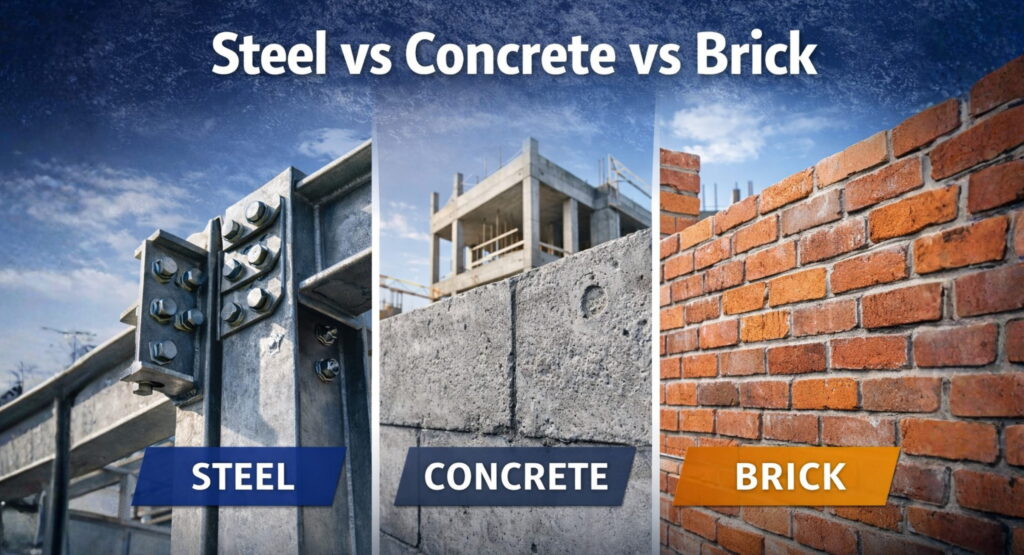
Steel is mainly used for reinforcement, structural frames, beams, columns, and industrial buildings.
Concrete is used for foundations, slabs, columns, beams, and structural components.
Brick is commonly used for walls, partitions, and low rise structures.
In most Pakistani homes, you will actually see a combination of all three materials.
1. Initial Material Cost in Pakistan
Steel
Steel prices in Pakistan fluctuate frequently due to dollar rate, scrap prices, and local demand.
Steel has a higher cost per ton compared to bricks and raw concrete materials. However, it provides high strength in smaller quantities. That means you may use less material to achieve better structural performance.
Steel is more expensive upfront but stronger per unit weight.
Concrete
Concrete is a mix of cement, sand, crush, and water.
The cost of concrete depends on cement prices and aggregate availability. Cement prices in Pakistan also fluctuate, but usually not as rapidly as steel.
Concrete is moderately priced and widely available across the country.
Brick
Brick is traditionally one of the most commonly used materials in Pakistan.
Bricks are relatively affordable per piece, but when you calculate the total number required for walls, transportation, and labor, the cost can increase significantly.
In rural areas, brick construction may be cheaper. In urban areas, labor and transportation raise the overall cost.
2. Labor Cost Comparison
Material cost is only part of the story. Labor plays a major role.
Steel construction requires skilled labor for cutting, bending, and fixing. Labor charges can be higher.
Concrete work also requires skilled workers, especially for proper mixing and curing.
Brick masonry is labor intensive because laying bricks takes time. Skilled masons are required to ensure proper alignment and strength.
In many cases, brick construction may appear cheaper in material cost but becomes expensive due to higher labor time.
3. Speed of Construction
Time is money in construction.
Steel structures are faster to erect, especially in commercial and industrial projects.
Concrete construction takes time because of formwork and curing periods.
Brick construction is slower because each brick is laid manually.
If you want faster project completion, steel and reinforced concrete structures are usually more efficient than traditional brick structures.
4. Durability and Maintenance
Steel
Steel is very strong and durable when properly treated. However, it needs protection against corrosion, especially in humid and coastal areas like Karachi.
Concrete
Concrete is highly durable and resistant to fire and weather conditions. Proper curing improves long term strength.
Brick
Brick structures are durable but may develop cracks over time due to settlement or poor workmanship.
In the long run, concrete and properly protected steel tend to perform better in modern construction.
5. Structural Strength and Safety
If we compare purely in terms of strength:
Steel is the strongest material among the three.
Concrete is strong in compression but weaker in tension, which is why steel reinforcement is added.
Brick has limited load bearing capacity compared to reinforced concrete structures.
For multi storey buildings and commercial projects in Pakistan, reinforced concrete with steel is the preferred choice for safety and compliance with building codes.
6. Long Term Cost Efficiency
Sometimes the cheapest material initially becomes expensive later.
Steel may cost more at first, but it can reduce foundation size and improve structural efficiency.
Concrete structures provide long term durability with minimal maintenance.
Brick structures may require more maintenance in the long run, especially if exposed to moisture.
When evaluating cost, always think beyond the initial price.
7. Climate Considerations in Pakistan
Pakistan has extreme heat, humidity in coastal areas, and seismic zones.
Steel and reinforced concrete perform better in earthquake resistant designs.
Brick alone is not ideal for high seismic areas unless properly reinforced.
In hot climates, concrete and brick provide better thermal mass compared to steel structures.
So Which is More Cost Effective in Pakistan?
For small houses, a combination of reinforced concrete and brick is usually the most practical and cost effective solution.
For commercial buildings, factories, and warehouses, steel structures can be more economical in the long term due to faster construction and high strength.
Pure brick structures are less common in modern multi storey construction due to safety and strength limitations.
The best approach is not choosing one material over another, but using each where it performs best.
Final Thoughts
Steel, concrete, and brick each have their role in Pakistan’s construction industry.
Steel offers high strength and faster construction.
Concrete provides durability and structural reliability.
Brick offers affordability for walls and traditional construction.
Instead of asking which one is cheapest, the better question is which combination gives you the best value for your specific project.
Smart construction is about balance, safety, and long term planning.
