
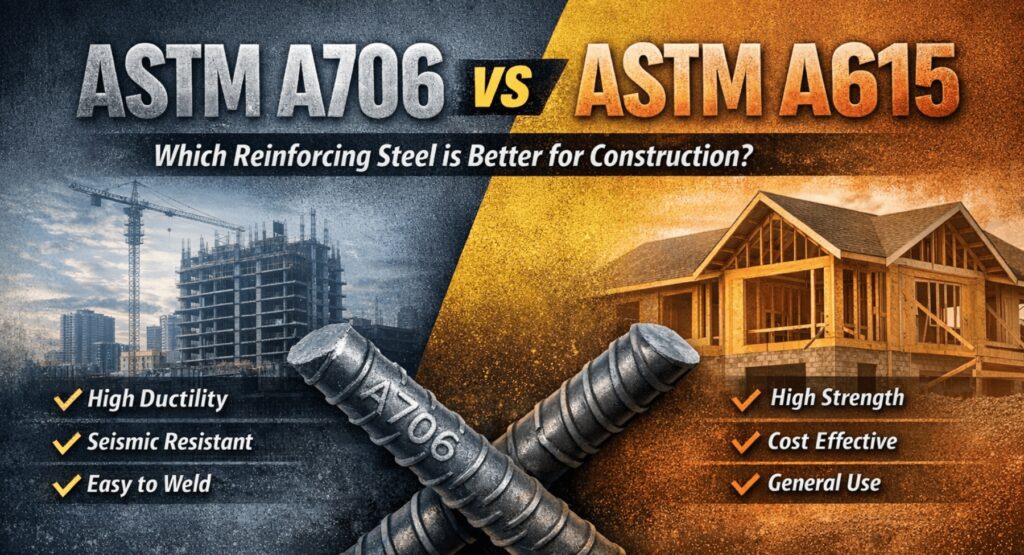
Reinforcing steel bars (rebar) play a critical role in determining the strength, durability, and safety of concrete structures. While concrete is strong in compression, steel reinforcement provides the tensile strength that allows buildings and infrastructure to withstand loads, vibrations, and environmental stresses.
Table of Contents
ToggleAmong international standards, ASTM A706 and ASTM A615 are two of the most wid
ely used specifications for reinforcing steel bars. Although both are ASTM standards, they are designed for very different construction needs.
This article offers a comprehensive comparison of ASTM A706 and ASTM A615, examining their respective strengths, ductility, weldability, seismic performance, applications, and suitability for Pakistan’s construction environment.
Understanding ASTM Steel Standards
ASTM (American Society for Testing and Materials) develops standards to ensure consistent quality, performance, and safety of construction materials worldwide. ASTM rebar standards define:
- Chemical composition
- Mechanical properties
- Yield and tensile strength
- Ductility and elongation
- Welding behavior
Choosing the correct ASTM standard is essential for structural reliability and long-term safety.
What Is ASTM A615?
ASTM A615 is a carbon steel reinforcing bar standard commonly used in general construction projects. It focuses primarily on achieving minimum strength requirements, making it a cost-effective option for many applications.
Key Characteristics of ASTM A615
- Made from carbon steel
- High tensile and yield strength
- Widely available and economical
- Not specifically designed for seismic resistance
- Welding is not recommended
Common ASTM A615 Grades
- Grade 40 – Minimum yield strength: 280 MPa
- Grade 60 – Minimum yield strength: 420 MPa
- Grade 75 – Minimum yield strength: 520 MPa
ASTM A615 is generally used where static loads dominate, and earthquake resistance is not a primary concern.
What Is ASTM A706?
ASTM A706 is a low-alloy, high-ductility reinforcing steel standard, specifically developed for seismic-resistant and critical structures.
Unlike A615, ASTM A706 controls not only the minimum strength but also the maximum yield strength, ensuring predictable and safer structural behavior under extreme conditions.
Key Characteristics of ASTM A706
- High ductility and elongation
- Excellent weldability due to low carbon equivalent
- Controlled yield strength limits
- Superior performance under cyclic and seismic loads
Common ASTM A706 Grades
- Grade 60 – Yield strength: 420 MPa
- Grade 80 – Yield strength: 550 MPa
ASTM A706 is preferred in earthquake-prone regions and for structures where human safety is critical.
ASTM A706 vs ASTM A615 – Detailed Comparison
1. Yield Strength Control
ASTM A706
- Has both minimum and maximum yield strength limits
- Prevents over-strength steel that can cause brittle failure
- Ensures predictable structural behavior
ASTM A615
- Only the minimum yield strength is specified
- No upper limit on yield strength
- Higher risk of sudden, brittle failure
✅ Advantage: ASTM A706
2. Ductility and Elongation
ASTM A706
- High ductility
- Can absorb energy by bending rather than breaking
- Ideal for dynamic and seismic loads
ASTM A615
- Moderate ductility
- More prone to sudden failure under extreme stress
✅ Advantage: ASTM A706
3. Seismic Performance
ASTM A706
- Specifically designed for seismic zones
- Performs well under repeated loading and vibrations
- Widely used in bridges, high-rises, and hospitals
ASTM A615
- Not designed for seismic resistance
- Suitable mainly for low-risk, non-seismic structures
✅ Advantage: ASTM A706
4. Weldability
ASTM A706
- Low carbon equivalent (CE)
- Welding is safe and recommended
- Ideal for complex structural joints
ASTM A615
- Higher carbon content
- Welding may cause cracking and strength loss
- Requires special procedures if welding is unavoidable
✅ Advantage: ASTM A706
5. Structural Safety and Failure Behavior
ASTM A706
- Fails gradually with visible deformation
- Provides a warning before collapse
- Enhances life safety during earthquakes
ASTM A615
- Can fail suddenly without warning
- Higher risk in critical structures
✅ Advantage: ASTM A706
6. Cost Consideration
ASTM A706
- Slightly more expensive due to alloy control and testing
- Higher upfront cost but better long-term safety
ASTM A615
- More economical
- Lower initial material cost
✅ Advantage: ASTM A615 (cost only)
Applications: Where Each Standard Is Best Used
ASTM A706 Applications
- High-rise buildings
- Bridges and flyovers
- Dams and power plants
- Hospitals and emergency facilities
- Seismic-zone infrastructure
ASTM A615 Applications
- Residential houses
- Low-rise commercial buildings
- Boundary walls and pavements
- Non-seismic structures
ASTM A706 vs ASTM A615: Which Is Better for Pakistan?
Pakistan lies near active tectonic zones, making earthquake resistance a serious concern, especially in cities like Islamabad, Quetta, Peshawar, and parts of KPK and Balochistan.
Why ASTM A706 Is a Safer Choice for Pakistan
- Better seismic performance
- Improved weldability for modern construction
- Higher structural reliability
- Compliance with international engineering best practices
For CPEC projects, high-rise developments, bridges, and public infrastructure, ASTM A706 is increasingly preferred by engineers and consultants.
Engineer’s Perspective: Strength Alone Is Not Enough
Many people assume that higher strength automatically means better steel. In reality:
Controlled strength + high ductility = safer structure
ASTM A706 achieves this balance, while ASTM A615 focuses mainly on strength.
Final Verdict: ASTM A706 vs ASTM A615
| Aspect | ASTM A706 | ASTM A615 |
| Ductility | High | Medium |
| Weldability | Excellent | Limited |
| Seismic Resistance | Excellent | Low |
| Yield Strength Control | Yes | No |
| Cost | Higher | Lower |
| Safety Level | Very High | Moderate |
Conclusion
- Choose ASTM A706 for critical, seismic, and long-life structures
- Choose ASTM A615 for general, low-risk construction projects
For builders, developers, and engineers who prioritize safety, compliance, and durability, ASTM A706 is the superior long-term investment.
