
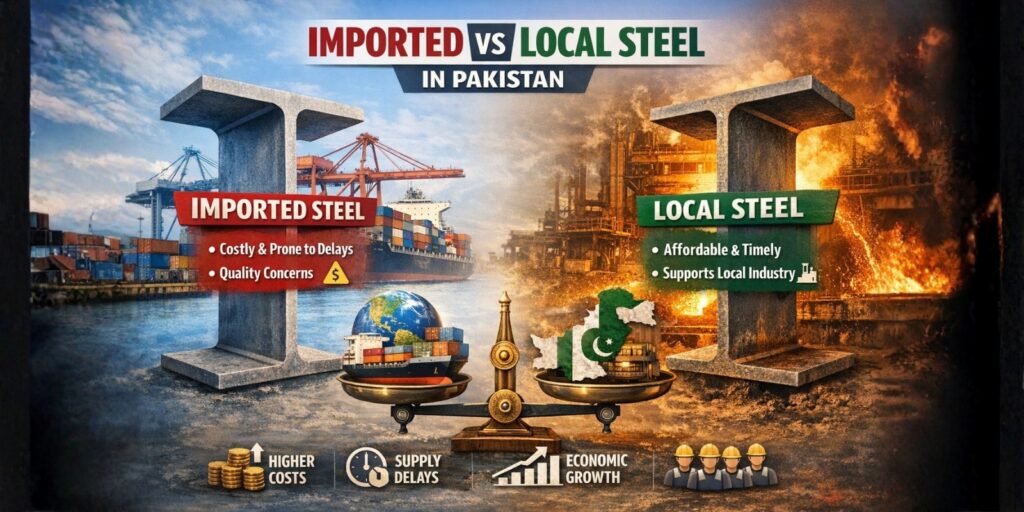
Steel is becoming one of the most discussed materials on every site due to Pakistan’s development boom. Builders must decide between locally produced and imported steel for everything from industries and small homes in Lahore, and this decision has an impact on both long-term steel performance and cost.
Price, brand-name, and visible finish don’t often tell the whole story, which confuses buyers. Local steel is frequently less expensive, yet imported steel is frequently thought to be superior.
This guide clears the fog. Continue reading to learn about the advantages and disadvantages of each option, how the supply chain operates, and useful pre-purchase tests to ensure your choice of steel meets the requirements of your project.
Table of Contents
ToggleOverview of Steel Sourcing in Pakistan
How the supply chain works
- Local mills manufacture sections, rebars, and billets, which they either sell to contractors or deliver directly for large projects.
- Before arriving at locations, imported steel goes through ports, importers, wholesalers, and regional distributors.
- The two flows differ greatly in terms of lead time, paperwork (duties and clearance), and logistics.
Major local producers
Mini-mills and integrated mills coexist in Pakistan’s steel sector. Rebar and typical structural sections used in residential and commercial buildings are the main products produced locally. Additionally, certain brands now have better capacity and uniformity because of recent investments, although mills still are different from one another.
Common countries Pakistan imports from: Pakistan imports a lot of finished and semi-finished steel from nearby exporters and global suppliers. Common origin regions include East Asia, West Asia, and Europe.
Imported Steel: Key Features & Market Perception
Any steel product manufactured overseas and imported into Pakistan after customs clearance is considered imported steel. This can include rebars, coils, plates, pipes, and specialty sections.
General quality expectations
Ideally, buyers expect better dimensional control, consistent chemistry, and consistent mechanical properties from imports, especially when they come from well-known mills in developed markets. Imported steel also arrives with mill test certificates and traceability paperwork, which builds buyer confidence.
Popular imported categories (Chinese, Turkish, Japanese, EU)
Examples of imports include high-end brands and inexpensive bulk sources. While Japanese and EU steel often targets high-spec, technically challenging projects, Chinese and Turkish materials usually compete on price and availability.
Advantages of Imported Steel
- Consistent quality: Consistent quality is enhanced on-site by uniform chemistry and tighter manufacturing tolerances.
- Advanced manufacturing standards: Mills with higher standards of quality, heat-treatment, and testing procedures are the source of some imports.
- Wider range of specialized grades: For projects requiring higher yields, special alloys, or certified coils/plates, imports often offer more options.
- Reliable performance in high-spec projects: When structural safety or engineered tolerance matters, imported steel reduces technical risk.
Disadvantages of Imported Steel
- Increased cost because of freight and duties: Import tax, shipping, and handling add an enormous fee.
- Longer lead times: Delays in shipping and customs might cause delays of days or weeks, which can be dangerous for those with busy schedules.
- Exchange-rate dependency: Prices shift in response to changes in the PKR and global market conditions, which makes budgeting less predictable.
- Problems with availability during project deadlines: When a cargo is delayed, contractors are unable to quickly replace it, which results in downtime.
Local Steel: Key Features & Market Perception
Construction-grade rebar and common structural sections that satisfy typical building requirements are the main products of local mills. Higher-grade parts for industrial usage are being supplied by some mills. Several mills have seen an increase in consistency as a result of investments in modern rolling and quality control.
As a result, the difference between basic local and lower-tier imports for regular building has decreased. Standard grades and supply are critical in public works, small businesses, and residential buildings, where local steel dominates.
Advantages of Local Steel
- Economical: Prices remain competitive due to lower landing costs and reduced logistics.
- Easily accessible: Material can be found at any time thanks to nearby mills.
- Faster delivery: Site supply is accelerated by shorter transportation and easier paperwork.
- Suitable for standard construction needs: Local grades usually work well for standard buildings and routine structural work.
Disadvantages of Local Steel
- Quality inconsistency across brands: Not all mills follow the same QC because buyer vigilance is needed.
- Limited advanced/specialty grades: For high-tech or specialized engineering needs, local options are limited.
- Some concerns in mega infrastructure projects: For very large or high-risk projects, engineers may prefer internationally certified materials.
Which One Should You Choose? (Based on Project Type)
Residential construction
Go local for speed and affordability when building a home. Every building necessity is satisfied by local rebar and sections. Even so, be sure to request basic mill documentation and choose reputable local brands.
Commercial buildings (small-to-medium)
In commercial buildings, local is usually fine if you confirm quality. For upscale or critical sections, consider importing structural members if the budget allows.
Industrial projects
The combined approach is generally favored for industrial projects. Imported for wear-prone parts or when a particular alloy chemistry is needed, and local for standard structures.
High-rise & mega projects
In high-end mega projects, prefer imported or internationally certified material for critical structural elements. Use local materials for non-critical or secondary work only if mill certificates match engineering specifications.
Specialized engineering applications
In this case, imported or specially sourced local material with full certification is ideally preferred. Always follow the engineer’s spec and do not substitute on price alone.
How to Verify Steel Quality Before Buying
Ask for Mill Test Certificates (MTC)
The supplier must provide the chemical composition, tensile strength, yield strength, elongation, and heat/coil identification. At the end, cross-check batch numbers against delivery tags.
PSQCA (and other standards) compliance
Look for PSQCA marks and certificates for locally manufactured products. For imports, check the mill’s international standards (ISO, EN, JIS) mentioned in the MTC.
On-site quick checks
- Visual: Uniform ribs, no excessive rust, clean surface for rebars.
- Dimensional: Verify diameter and rib spacing with calipers.
- Sample bend test (for rebars): A small, supervised bend test can help identify ductility issues.
- Document check: Delivery challans must match MTC batch numbers.
Third-party / lab testing for big projects
Send samples for tensile & chemical tests at an accredited lab before full acceptance. And make sure to use non-destructive testing (NDT) for welded sections or critical plates if required.
Final Recommendation
When imported steel makes sense
- High-spec, certified grades are required for your project (high-rise core, bridges, pressure vessels).
- Accurate mechanical characteristics and global traceability are essential.
- You can tolerate increased expenses and longer lead times.
When local steel is the better value
- Tasks that must be done on a tight budget (residences, small businesses, nearby factories).
- Projects that must be completed quickly because of strict deadlines.
- When the engineer’s specifications match local grades, and local mills provide reliable MTCs.
Conclusion
Don’t make your decision between local and imported goods just on cost. Always ensure that the steel grade and characteristics match the project’s structural requirements. For each essential structural component, get documentation (MTC, standards compliance) and, if required, third-party testing.
