
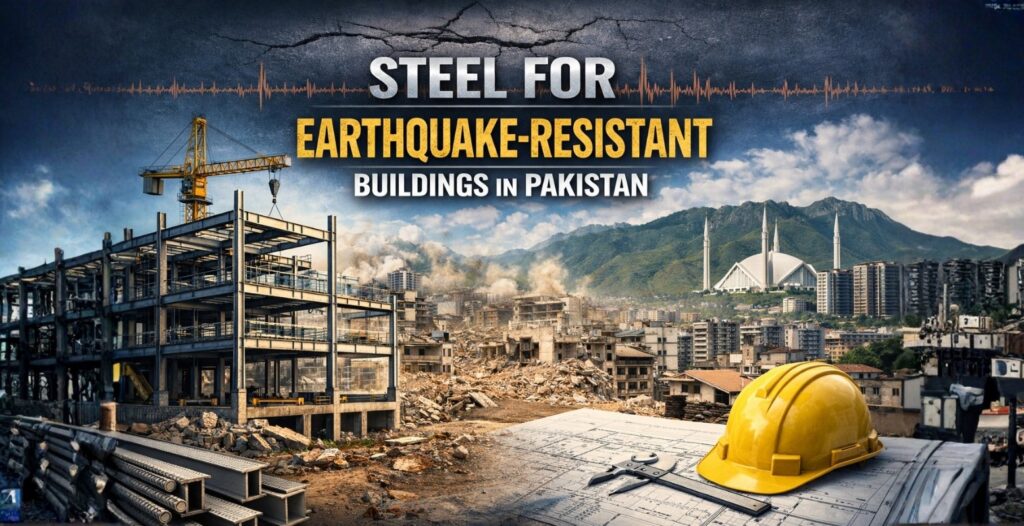
Pakistan lies in an active seismic zone due to the collision of the Indian and Eurasian tectonic plates. Cities like Islamabad, Quetta, and the northern regions are at high risk of earthquakes. Traditional construction methods, especially unreinforced masonry, have repeatedly failed during major seismic events.
This is where structural steel becomes important.
Steel is not just strong. It is ductile, flexible, and capable of absorbing energy. These properties make it one of the most reliable materials for earthquake-resistant buildings in Pakistan.
Table of Contents
ToggleWhy Earthquake-Resistant Construction Matters in Pakistan
Pakistan has experienced devastating earthquakes, including the 2005 Kashmir earthquake. The real issue was not only the magnitude but also poor construction practices.
Common problems include:
- Brittle materials like brick and plain concrete
- Lack of seismic design compliance
- Weak structural connections
- Poor engineering standards in residential buildings
This has increased demand for:
- Seismic-resistant structures
- Steel frame buildings in Pakistan
- Earthquake-safe house design
Why Steel is Ideal for Earthquake-Resistant Buildings
1. Ductility
Steel can bend without breaking. During an earthquake, buildings are exposed to strong lateral forces.
Concrete tends to crack and fail under stress. Steel can deform and still maintain its integrity. This makes it ideal for seismic-resistant design.
2. High Strength-to-Weight Ratio
Steel structures are lighter than traditional concrete buildings.
Lower weight means lower seismic force acting on the structure. This improves overall performance during earthquakes. This is why lightweight steel structures in Pakistan are becoming more popular.
3. Energy Absorption
Steel has the ability to absorb and dissipate energy during seismic activity.
This reduces the chances of sudden collapse and limits structural damage. It plays a key role in earthquake-resistant steel structures.
4. Design Flexibility
Steel allows engineers to use advanced structural systems such as:
- Moment-resisting frames
- Braced frames
- Base isolation systems
These systems improve stability and are widely used in the seismic design of buildings in Pakistan.
5. Faster and More Accurate Construction
Steel components are often prefabricated in controlled environments.
This results in:
- Faster construction timelines
- Better quality control
- Reduced chances of human error
This is especially useful in cities like Karachi and Lahore, where time and efficiency matter.
Types of Steel Structures Used in Pakistan
Steel Frame Structures
These consist of beams and columns forming the main structure. They are commonly used in commercial buildings.
Pre-Engineered Buildings
These are manufactured in factories and assembled on site. They are widely used in warehouses and industrial projects.
Composite Structures
These combine steel and concrete to balance strength and cost. They are common in modern construction projects.
Seismic Design Standards in Pakistan
Pakistan follows several building codes and standards, including:
- Building Code of Pakistan for seismic provisions
- International standards such as UBC and IBC
The main issue is not the lack of standards but weak enforcement, especially in residential construction.
Cost Consideration
Steel construction has a higher initial cost compared to traditional methods.
However, it offers long-term benefits:
- Lower maintenance costs
- Higher durability
- Reduced damage during earthquakes
When risk and safety are considered, steel becomes a cost-effective option for earthquake-resistant buildings in Pakistan.
Challenges in Pakistan
Lack of Awareness
Many people still prioritize cost over safety.
Shortage of Skilled Labor
Steel construction requires trained professionals and proper supervision.
Weak Enforcement of Regulations
Building codes are often ignored in smaller residential projects.
Misconceptions About Cost
Many developers avoid steel due to its upfront cost without considering long-term benefits.
Future of Steel Construction in Pakistan
The demand for steel construction is increasing due to:
- Rapid urbanization
- Increased awareness after past earthquakes
- Growth in high-rise and commercial projects
Search trends show rising interest in:
- Modern construction techniques in Pakistan
- Steel building cost in Pakistan
- Earthquake-proof house design
Conclusion
Steel offers flexibility, strength, and energy absorption, which are essential for earthquake-resistant structures.
For a country like Pakistan, relying only on traditional construction methods is risky. Steel provides a safer and more reliable solution for modern buildings.
Investing in earthquake-resistant steel buildings is not just a technical choice. It is a necessity for long-term safety and sustainability.
