
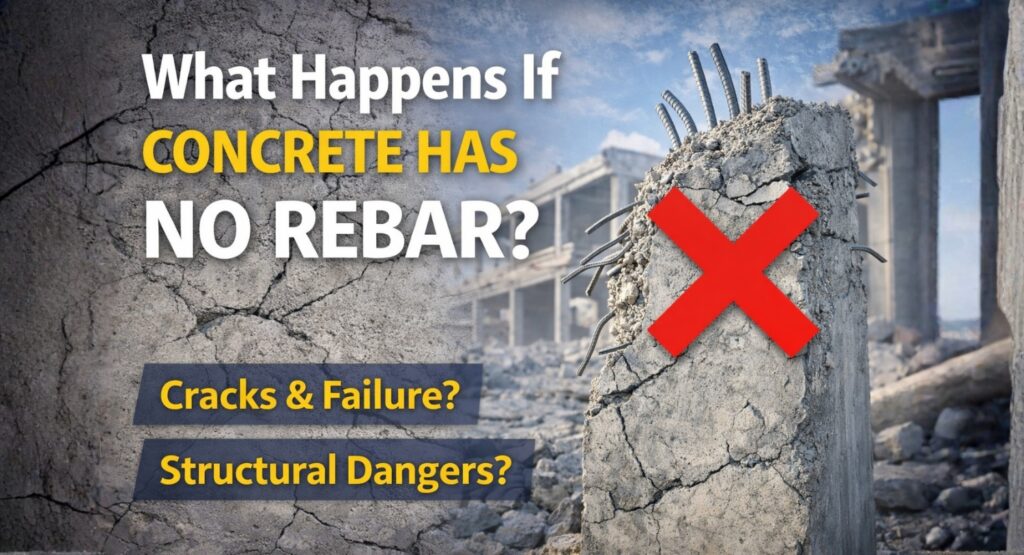
Concrete is one of the most widely used construction materials in the world. From residential homes to commercial buildings and bridges, it plays a vital role in modern infrastructure. But have you ever wondered what happens if concrete is used without rebar reinforcement?
At first glance, concrete looks extremely strong and it is. However, concrete has a critical weakness that can lead to cracking, structural failure, and long-term safety risks if it isn’t reinforced properly.
Let’s break it down in simple terms.
Table of Contents
ToggleUnderstanding Concrete’s Natural Strength
Concrete is very strong in compression. This means it can handle heavy weight pushing down on it, like the load of floors, roofs, and vehicles.
However, concrete is very weak in tension. Tension happens when a structure bends, stretches, or experiences pulling forces. These forces occur frequently due to:
- Temperature changes
- Ground movement
- Wind pressure
- Earthquakes
- Heavy traffic loads
Without reinforcement, concrete cannot properly resist these forces.
What Is Rebar and Why Is It Important?
Rebar (reinforcing bar) is steel placed inside concrete to strengthen it. When concrete and steel work together, they create a material that is strong in both compression and tension.
If you want a detailed breakdown of reinforcement types and applications, you can explore a complete steel rebar guide to understand its uses, grades, manufacturing process, and advantages.
Rebar dramatically increases structural stability, durability, and safety.
What Happens If Concrete Has No Rebar?
Let’s look at the real consequences.
1. Cracking Becomes Inevitable
Concrete naturally shrinks as it dries. Without reinforcement:
- Shrinkage cracks appear
- Surface cracks spread over time
- Structural cracks form under stress
Even small cracks can allow water to enter, leading to further damage.
2. Reduced Load-Bearing Capacity
Concrete without rebar cannot safely handle bending or tensile stress.
For example:
- A concrete slab without reinforcement can crack under vehicle weight.
- A beam without steel support may fail suddenly.
Reinforcement bars distribute stress evenly throughout the structure.
3. Higher Risk of Structural Failure
In reinforced concrete, steel absorbs tensile forces while concrete handles compression. Without rebar:
- The structure becomes brittle.
- Failure happens suddenly, not gradually.
- Safety risks increase significantly.
This is especially dangerous in multi-story buildings, bridges, and foundations.
4. Poor Earthquake Resistance
During earthquakes, buildings experience intense sideways forces (lateral loads).
Concrete without reinforcement:
- Cannot flex
- Cannot absorb shock
- Breaks instead of bending
Reinforced concrete structures are designed to withstand seismic activity.
5. Shorter Lifespan
Unreinforced concrete structures:
- Crack faster
- Allow moisture penetration
- Deteriorate quicker
- Require frequent repairs
In contrast, properly reinforced concrete can last decades with minimal maintenance.
Where Can Concrete Be Used Without Rebar?
There are some limited cases where concrete may not require reinforcement:
- Sidewalks (light use)
- Small garden pathways
- Decorative slabs
- Non-load-bearing surfaces
However, even in these cases, light reinforcement mesh is often recommended.
Rebar vs No Rebar: Simple Comparison
| Feature | Concrete Without Rebar | Reinforced Concrete |
| Crack Resistance | Low | High |
| Load Capacity | Limited | Strong |
| Earthquake Safety | Poor | Much Better |
| Lifespan | Shorter | Longer |
| Structural Safety | Risky | Reliable |
Why Modern Construction Always Uses Reinforcement
Today, almost all structural concrete includes reinforcement. And not just any steel — many builders prefer high-strength options like TMT steel bars, which offer better flexibility and bonding compared to ordinary rebar.
If you’re comparing materials, understanding the difference between ordinary reinforcement and advanced TMT options is essential before starting any project.
The Science Behind Reinforced Concrete
Concrete and steel work together because:
- They expand and contract at similar rates.
- Steel bonds strongly with concrete.
- Steel prevents tensile cracking.
This combination creates what engineers call reinforced concrete, one of the most reliable building materials in the world.
Real-World Example
Imagine a concrete bridge without rebar.
Under constant traffic load:
- The underside of the bridge experiences tension.
- Cracks form quickly.
- The bridge weakens over time.
- Structural collapse becomes a risk.
This is why rebar is mandatory in serious construction projects.
Can Fiber Replace Rebar?
Some projects use fiber-reinforced concrete. While fibers improve crack control, they do not fully replace structural rebar in major load-bearing applications.
For foundations, beams, columns, and slabs — steel reinforcement remains essential.
Final Thoughts
Concrete alone is strong, but incomplete.
Without rebar:
- Cracking increases
- Structural strength decreases
- Safety risks rise
- Lifespan shortens
Reinforcement transforms concrete into a durable, safe, and long-lasting building material.
Whether you’re building a house, commercial structure, or infrastructure project, understanding reinforcement is critical. Choosing the right type of steel reinforcement ensures long-term performance and structural integrity.
Conclusion
Concrete without rebar is like a body without bones. It may stand temporarily, but it cannot handle stress for long.
Modern construction depends on reinforced concrete for strength, flexibility, and safety. Investing in proper reinforcement today prevents costly failures tomorrow.
