
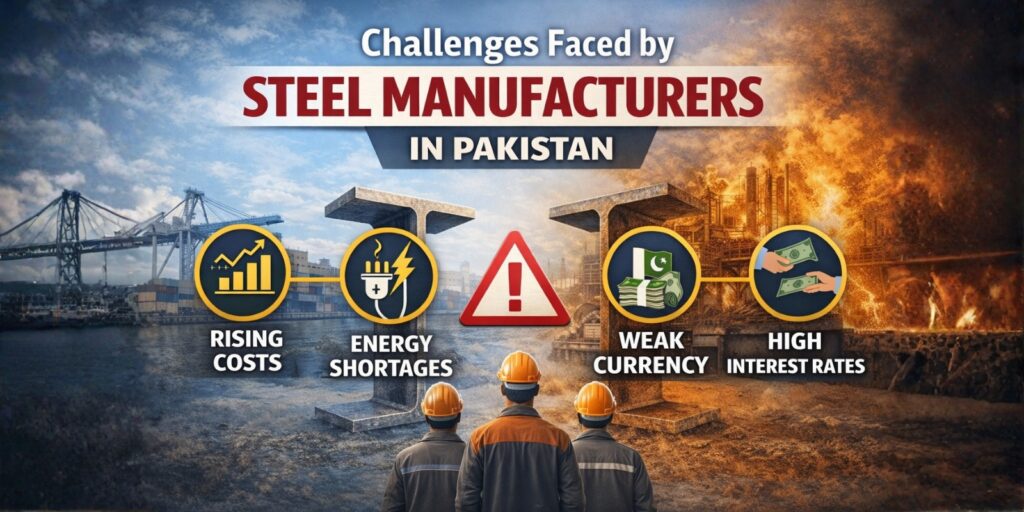
There is no doubt that Pakistan’s steel industry plays a critical role in supporting construction, infrastructure, and industrial growth. From housing projects to large-scale developments, steel manufacturers are the backbone of this progress. However, operating a steel manufacturing business in Pakistan is a challenging task, as manufacturers face a range of economic, regulatory, and operational challenges that directly impact production costs.
Understanding these challenges is important not only for industry stakeholders but also for those who rely on locally produced steel. Below, we’ve shared the top 8 challenges faced by steel manufacturers in Pakistan.
8 Common Challenges Faced by Steel Manufacturers in Pakistan
Challenge No. 1: Rising Energy Costs
Energy is one of the most expensive components in steel manufacturing. In Pakistan, frequent increases in electricity and gas tariffs put immense pressure on steel producers. Keep in mind that steel plants require continuous power for furnaces, rolling mills, and cooling processes, and any rise in energy price can directly increase per-ton production costs.
This unpredictability in energy pricing also makes long-term planning of large-scale projects difficult and forces manufacturers to either reduce margins or increase the final price to customers.
Challenge No. 2: Volatile Raw Material Prices
It is not hidden from anyone that steel manufacturers depend heavily on raw materials like billets, scrap metal, and iron ore. Since many of these raw materials are imported into Pakistan, manufacturers also bear the weight of changes in global prices and currency devaluation. Not to forget that sudden changes in global steel and scrap prices can disrupt cost structures overnight.
It is also worth noticing that the local availability of quality scrap is limited, which increases manufacturers’ dependency on imports. This volatility makes it difficult for manufacturers to maintain stable pricing for customers while protecting their own profitability in a highly competitive market.
Challenge No. 3: Currency Devaluation and Import Dependency
The Pakistani rupee’s depreciation against major currencies like the USD has a direct impact on the steel manufacturing industry. Since machinery, spare parts, and other major raw materials are often imported, currency fluctuations single-handedly raise upfront costs. Even small changes in exchange rates can significantly increase overall production expenses.
Not only that, but import delays due to foreign exchange shortages can further slow down operations. This dependency creates uncertainty and makes it harder for manufacturers to forecast costs, negotiate contracts, and remain competitive.
Challenge No. 4: Inconsistent Quality Standards Across the Market
One major issue facing the steel industry is the lack of consistent quality enforcement. While reputable manufacturers follow ASTM and international standards, many small or unregulated producers compromise on quality to reduce costs. This creates unfair competition and damages overall market trust, because low-quality steel is cheap and unreliable to stand tall for decades to come.
Contractors and buyers also struggle to differentiate between high-quality and cheap steel, which puts them at a disadvantage from the get-go. For manufacturers who invest in quality control, testing, and compliance, competing with low-quality products sold at cheaper rates becomes a serious commercial challenge.
Challenge No. 5: Outdated Technology and Limited Modernization
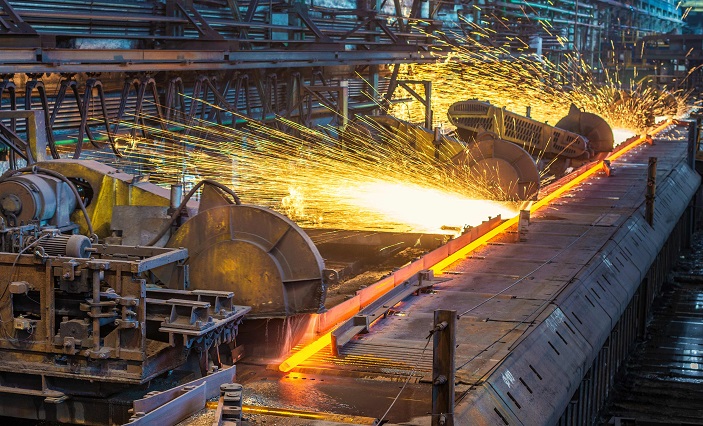
Many steel manufacturers in Pakistan still operate with the same outdated machinery and production methods, which are not effective anymore. Among the major reasons for this is limited access to financing and high import costs to purchase modern equipment. As a result, production efficiency remains low compared to global standards.
Not to forget that outdated technology also affects product consistency and waste management. While some modern plants focus on automation and precision, manufacturers using aging systems may struggle to compete on quality and cost. This technology gap limits productivity growth, which affects the manufacturing industry as a whole.
Challenge No. 6: Skilled Labor Shortage
Steel manufacturing requires trained engineers, technicians, and skilled operators to maintain quality and safety standards. In Pakistan, there is a noticeable shortage of such technical labor in the steel sector. Many skilled workers migrate abroad for better opportunities, leaving local manufacturers with limited talent pools. Training new workers takes time and resources, which also increases operational costs if there are no good mentors available.
Challenge No. 7: Environmental and Compliance Pressures
Environmental regulations are becoming stricter, and steel manufacturers are under immense pressure to reduce emissions, waste, and energy consumption. While there is nothing bad in it, implementing such environmentally friendly processes at such a large scale requires significant investment in cleaner technology and waste treatment systems, which many steel manufacturers can not afford.
As a result, many manufacturers struggle to balance that cost with profitability. Not to forget that inconsistent enforcement of environmental laws can also create uneven competition, which disrupts the industry as a whole.
Challenge No. 8: Market Competition and Price Undercutting
Over the years, the Pakistani steel market has become highly competitive, with both local and imported products available to the customer. Price undercutting by unregistered or non-compliant manufacturers creates intense pressure on established producers, who follow high-quality global standards, which automatically increases the cost structure.
Not to mention that customers sometimes also prioritize lower prices over quality, which forces reputable manufacturers to defend value-based pricing. This competition discourages long-term investment in quality, innovation, and infrastructure, which disrupts the overall market.
Conclusion
Steel manufacturers in Pakistan operate in a demanding environment, which is shaped by economic uncertainty, regulatory pressures, and operational constraints. From energy costs and raw material volatility to skill shortages and market competition, these are just some of the most common challenges that affect steel production efficiency and long-term growth.
FAQ’s
1. Why are energy costs a major issue for steel manufacturers in Pakistan?
Because steel production is energy-intensive, frequent increases in electricity and gas prices directly affect cost and profitability.
2. How does currency devaluation affect steel manufacturing?
A weaker currency increases the cost of imported raw materials, machinery, and spare parts, making production more expensive.
3. Are quality standards enforced across the steel industry?
Enforcement exists, but inconsistent compliance allows low-quality producers to compete unfairly with manufacturers following international standards.
4. Why is modernization slow in Pakistan’s steel sector?
High equipment costs, limited financing options, and economic uncertainty are key factors.
5. What can help improve the future of steel manufacturing in Pakistan?
Stable policies, fair regulation, skilled workforce development, and investment in modern, energy-efficient technology.
