
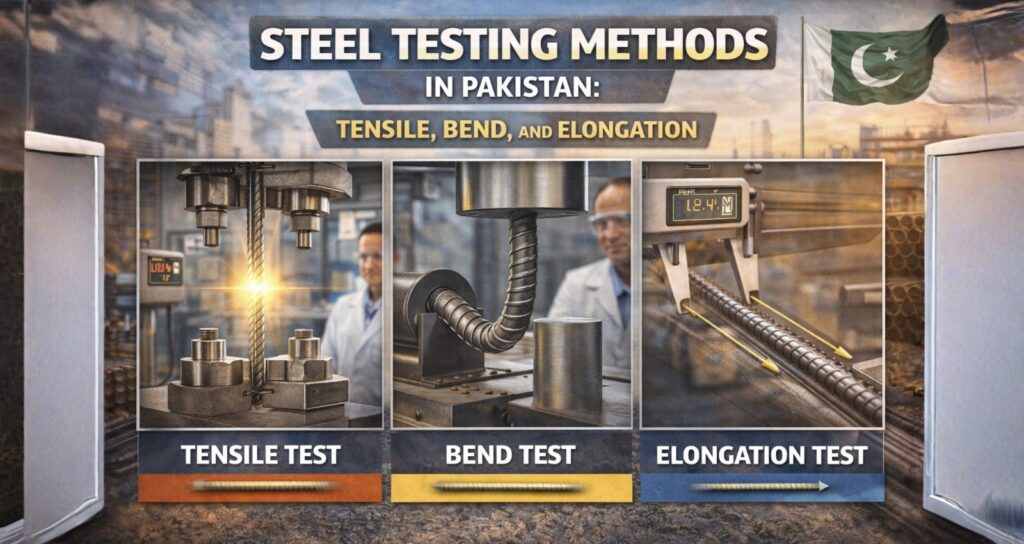
Steel quality plays a critical role in construction safety. In Pakistan, where buildings face heavy loads, seismic activity, and long-term environmental stress, steel testing is not optional, it is essential. Whether it is a residential house, a commercial building, or a major infrastructure project, steel must be tested to ensure it meets required strength and performance standards.
This blog explains the most common steel testing methods used in Pakistan, including tensile test, bend test, and elongation test, in a clear and easy-to-understand way.
Table of Contents
ToggleWhy Steel Testing Is Important in Pakistan
Pakistan’s construction industry relies heavily on reinforced concrete structures. Poor-quality steel can lead to cracks, structural weakness, or even collapse. Steel testing helps ensure that steel bars:
- Meet ASTM and British Standards
- Can safely carry design loads
- Perform well during earthquakes
- Provide long-term durability
Government bodies, consultants, and engineers in Pakistan require steel testing to verify quality before and during construction.
Common Steel Testing Standards Used in Pakistan
Steel bars in Pakistan are usually tested according to international standards, such as:
- ASTM standards (ASTM A615, ASTM A706)
- British Standards (BS 4449 G500)
- PCSIR and approved third-party laboratories
These standards define how steel should be tested and what results are acceptable.
1. Tensile Test of Steel Bars
What Is a Tensile Test?
The tensile test measures how much pulling force (tension) a steel bar can handle before it breaks. It is one of the most important tests for steel bars used in construction.
How the Tensile Test Is Performed
- A steel bar sample is placed in a Universal Testing Machine (UTM)
- The machine pulls the bar from both ends
- Force is applied until the steel bar fractures
During the test, key values are recorded.
What the Tensile Test Measures
- Yield Strength – the point where steel starts to deform permanently
- Ultimate Tensile Strength – the maximum load steel can handle
- Breaking Point – when the steel finally breaks
Why Tensile Testing Matters
Tensile testing ensures steel bars can safely support loads in columns, beams, and slabs. In Pakistan, tensile testing is mandatory for ASTM and BS-grade steel bars.
2. Bend Test of Steel Bars
What Is a Bend Test?
The bend test checks the flexibility and ductility of steel bars. It ensures that steel can bend without cracking, especially important for seismic-resistant structures.
How the Bend Test Is Performed
- A steel bar is bent around a fixed diameter mandrel
- The bending angle is usually 90°, 135°, or 180°, depending on the standard
- The surface of the bar is examined for cracks or fractures
What the Bend Test Checks
- Surface cracking
- Internal weaknesses
- Manufacturing defects
Importance of Bend Test in Pakistan
Bend testing is especially important for earthquake-prone regions. Steel that fails a bend test can break suddenly during seismic activity, making structures unsafe.
3. Elongation Test of Steel Bars
What Is an Elongation Test?
The elongation test measures how much a steel bar can stretch before breaking. It indicates the ductility of steel.
How Elongation Is Measured
- Steel length is measured before testing
- After tensile failure, the final length is measured
- Elongation is calculated as a percentage
Why Elongation Matters
Higher elongation means steel can absorb energy and deform without sudden failure. This property is crucial for:
- Seismic-resistant buildings
- High-rise structures
- Bridges and infrastructure projects
ASTM A706 and BS 4449 steel bars usually require higher elongation values compared to general-purpose steel.
ASTM A706 vs ASTM A615: A Complete Comparison of Reinforcing Steel Standards
Comparison of Steel Testing Methods
| Test Type | Purpose | Importance |
| Tensile Test | Measures strength | Ensures load-carrying capacity |
| Bend Test | Checks flexibility | Prevents cracking and brittle failure |
| Elongation Test | Checks flexibility | Improves earthquake performance |
Steel Testing and Construction Safety
Steel testing helps engineers select the right steel grade for each project. A steel bar that passes tensile but fails elongation or bend testing may not be suitable for seismic applications.
That is why all three tests together provide a complete picture of steel quality.
Steel Testing Practices in Pakistan
In Pakistan, steel testing is commonly done:
- At steel mills during production
- By third-party laboratories
- At construction sites for verification
Builders and consultants increasingly prefer manufacturers who follow strict internal quality control and provide test certificates.
Final Thoughts
Steel testing is the foundation of safe construction in Pakistan. Tensile, bend, and elongation tests ensure steel bars meet international standards and perform reliably in real-world conditions.
Choosing tested and certified steel reduces structural risk, improves safety, and ensures long-term durability for any construction project.
